
Pull the last quarter of refund data and look at the reason column. In most stores it tells you almost nothing. “Other” shows up more than any single real reason. “Customer request” covers everything from a genuine defect to a shopper who changed their mind twice. Nobody can act on a column like that, so nobody does — the refunds keep processing, the money keeps leaving, and the report gets filed without a decision attached to it.
That gap is where refund reason codes ecommerce teams actually rely on start to matter. A reason code is not a customer service formality. It is the label that decides whether a refund gets treated as a one-off or as evidence of a pattern worth fixing. Get the taxonomy wrong and every refund looks like an isolated event, even when forty of them this month trace back to the same packaging supplier or the same misleading product photo.
Why “Other” Is the Most Expensive Label in Your Refund Data
Every refund reason field eventually collects a catch-all bucket, and that bucket grows faster than any operator expects. It starts as 3% of refunds. Six months later it is 20%, and nobody remembers deciding that was acceptable. The reason is structural, not personal — agents process refunds under time pressure, the dropdown rarely fits the actual situation, and the fastest option wins.
The cost is not the refund itself. It is the loss of the decision the refund was supposed to inform. A defect trend hiding inside “other” doesn’t get escalated to sourcing. A sizing problem hiding inside “customer request” doesn’t get flagged to the product page. A courier that keeps damaging one SKU doesn’t get a packaging review. The refund rate stays the same or creeps up, and the team keeps treating each case as unrelated because the data never forced the connection.
Return-reason analysis exists precisely to close that gap: connecting the reason a customer gives to the internal root cause, the team responsible, and whether the pattern is preventable. Broad, vague categories block any meaningful operational conclusion, even when the underlying data volume is large. A taxonomy only earns its place in the operation if it forces a decision at the other end.
Why the Customer’s Stated Reason Is Not the Root Cause
Refund forms usually ask the customer to pick a reason, and most platforms treat that pick as the final answer. It rarely is. A shopper selecting “changed my mind” might be covering for a product that didn’t match the photos, because that option is faster and doesn’t invite an argument. A shopper selecting “defective” might have simply misused the product. The label the customer chooses reflects what gets the refund approved with the least friction, not what actually happened.
Broader industry return-reason research backs this up: across ecommerce generally, the majority of returns trace back to customer selection — sizing, fit, or a simple change of mind — with a smaller share tied to catalog or listing mismatches, and a smaller share still to genuine product or delivery failures. The split matters because most teams pour attention into the smallest bucket, chasing defect counts, while the largest category gets written off as unfixable and left alone. It usually isn’t unfixable. It’s a sizing chart that needs work, a product description that oversells, or a category page that sets the wrong expectation before the customer even clicks through.
This is the argument for separating the customer-facing reason from the internal reason code. Keep the shopper-facing dropdown short and low-friction at the point of request. Route the operational taxonomy to a second layer — the person processing the refund, or a weekly review — where someone with context assigns the code that actually reflects what happened. The two labels will disagree more often than most teams expect, and that disagreement is the signal, not noise to be smoothed over.
A Practical Six-Category Refund Reason Taxonomy
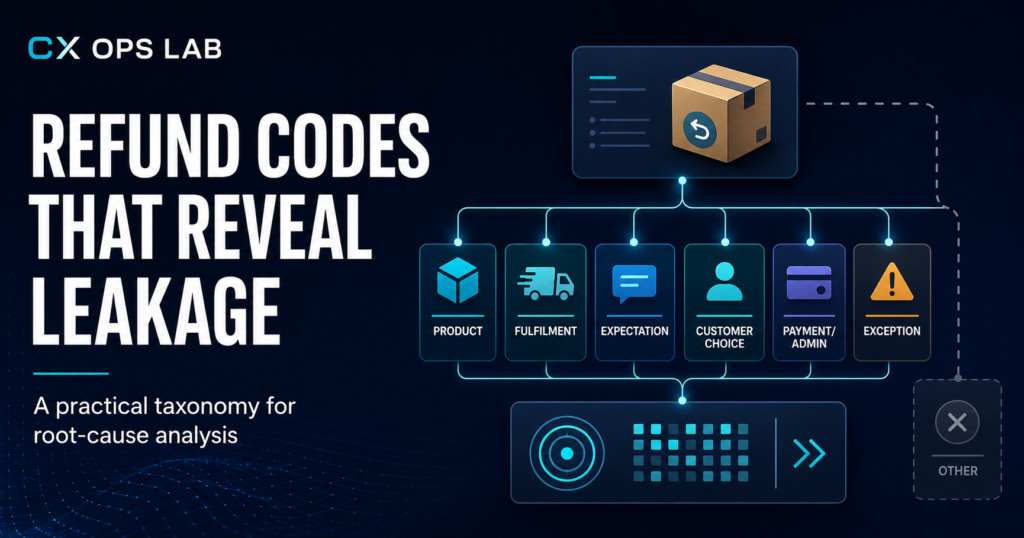
A workable taxonomy has to survive contact with a busy support queue, which means it can’t have thirty options. Six top-level categories, each with two or three sub-codes, covers the large majority of cases in a typical DTC operation without forcing agents to guess.
1. Product
The item itself failed to meet spec — a manufacturing defect, a missing component, a quality variance between batches, or a functional failure reported after use. This category should route straight to whoever owns supplier relationships or quality control, because a cluster here points at a sourcing or manufacturing issue rather than a one-off unlucky unit.
2. Fulfilment
The product was fine, but something happened between the warehouse and the doorstep: wrong item picked, incorrect size or variant shipped, damaged in transit, or lost by the carrier. Fulfilment errors are operationally distinct from product defects, because the fix sits with warehouse process or carrier performance, not with the manufacturer.
3. Expectation Gap
The product matched its build quality but not what the customer expected going in — colour looked different online, sizing ran small or large against the chart, material felt different than described, or the listing implied a feature the product doesn’t have. Merchandising and content teams need visibility into this category, because it is rarely a single bad refund; it’s a pattern tied to one product page.
4. Customer Choice
No fault on the brand’s side. The customer ordered a duplicate, bought a gift that wasn’t wanted, simply changed their mind, or found a cheaper option elsewhere. These refunds are a normal cost of doing ecommerce and shouldn’t trigger operational panic, but they still need to be counted accurately so they don’t get miscoded as something more actionable than they are.
5. Payment / Admin
The refund is correcting an internal error rather than resolving a product complaint: duplicate charge, pricing error at checkout, a discount that didn’t apply correctly, or a billing dispute. These belong to finance and platform operations, not to CX, and mixing them into product-quality reporting quietly inflates a defect rate that isn’t real.
6. Exception
Fraud holds, chargebacks, goodwill refunds issued outside normal policy, and cases that don’t fit cleanly anywhere else. Keep this bucket small on purpose — if it grows past a low single-digit percentage of total refunds, that’s usually a sign the other five categories need better sub-codes, not that “exception” needs to absorb more volume.
Assigning every refund into one of these six buckets, even roughly, turns a support log into something operations, merchandising and finance can each use for their own decisions. The category alone often tells you who should own the fix before you’ve read a single case note.
Quick-Reference Taxonomy Table
| Category | What It Covers | Typical Owner |
|---|---|---|
| 1. Product | Manufacturing defect, missing component, batch quality variance, functional failure | Supplier / QC |
| 2. Fulfilment | Wrong item picked, wrong size/variant shipped, damaged in transit, lost by carrier | Warehouse lead |
| 3. Expectation Gap | Colour/material mismatch, sizing vs. chart, listing overpromises a feature | Merchandising / content |
| 4. Customer Choice | Duplicate order, unwanted gift, changed mind, found cheaper elsewhere | CX (no escalation needed) |
| 5. Payment / Admin | Duplicate charge, checkout pricing error, discount error, billing dispute | Finance / platform ops |
| 6. Exception | Fraud hold, chargeback, out-of-policy goodwill refund, uncategorized edge case | CX lead / founder |
Refund Reason Codes and the Replacement-vs-Refund Decision
Reason codes get more useful once they’re connected to what happens next. A Product-category refund on a low-cost item is often better resolved with a replacement than a refund, and the decision changes again depending on shipping cost, remaining stock and the customer’s history. If your team hasn’t formalized when a replacement protects margin better than a refund, that decision logic is covered in our replacement vs. refund breakdown — worth reading alongside the taxonomy above, since the two decisions usually happen in the same ticket.
None of this requires new software. A shared tracker with order ID, reason category, sub-code, cost impact and owner is enough to start. What it requires is a documented taxonomy nobody argues about mid-shift, and a rule that “other” needs a reason attached before the refund is closed, not just a checkbox.
In one multi-platform DTC operation processing 9,025 orders over nine months across Shopify, Shopee and Lazada, refunds ran at 1.71% of total volume — low enough to be defensible to a platform or a partner, but only because every refund carried a reason that could be reviewed, not just approved and forgotten.
| Fix the Data Before You Fix the ProcessIf your refund data currently tells you the dollar amount and nothing else, this is usually the first gap worth closing before anything more advanced gets built on top of it. The Return & Refund Operations Handbook includes the full reason-code taxonomy above as a ready-to-use tracker, along with the approval matrix and escalation thresholds that sit downstream of it — built from a real operation, not a template pulled from a generic returns guide.Get the Return & Refund Operations Handbook → |
Turning Reason Codes Into a Weekly Decision, Not a Monthly Report
A taxonomy that only gets reviewed at quarter-end is not doing its job. The categories above are only worth building if someone looks at the rollup often enough to catch a pattern while it’s still small. A short weekly cadence works better than a long monthly one for this specific data, because the cost of a defect trend or a mislabeled product page compounds every day it goes unaddressed.
A few things make the review actually produce decisions instead of just information:
- Assign an owner to each category, not to the refund process as a whole. Product-category spikes go to whoever manages supplier quality. Fulfilment spikes go to the warehouse lead. Expectation-gap spikes go to whoever owns the product page copy. If one person is meant to fix everything, nothing specific gets fixed.
- Set a simple trigger, not a perfect statistical threshold. If a single sub-code doubles week over week, or if any one SKU accounts for more than a small share of a category’s volume, that’s worth a five-minute look before it becomes a pattern nobody remembers starting.
- Track resolution, not just detection. A reason code that gets flagged but never leads to a supplier call, a copy edit or a packaging change isn’t producing value — it’s just better-organized inaction. Log what changed as a result of each flagged pattern, even a one-line note, so the taxonomy proves its worth over a quarter rather than being taken on faith.
For teams already dealing with returned inventory sitting in the warehouse because nobody assigned it an owner, the same ownership logic applies downstream — our piece on warehouse return management covers what happens after the refund is approved and the physical item comes back.
Where This Fits in a Return and Refund Operation
Refund reason codes are one piece of a larger operating system, alongside eligibility rules, an approval matrix for exceptions, and a defined handoff to the warehouse when goods come back. Building all of it from scratch under deadline pressure is how most teams end up with a taxonomy nobody trusts and a dropdown menu that grew by accident.
If refund data at your store currently raises more questions than it answers — which categories are growing, which SKUs are quietly bleeding margin, who’s supposed to act on any of it — that’s exactly the gap a documented refund reason codes taxonomy is built to close.
| Stop Guessing Which Refunds MatterThe Return & Refund Operations Handbook gives you the reason-code taxonomy above as a working tracker, plus the approval matrix and escalation rules that turn refund data into a repeatable process instead of a monthly spreadsheet nobody opens.Get the Return & Refund Operations Handbook — $39 → |
About CX Ops Lab
CX Ops Lab publishes operational frameworks, SOP templates, and case-study content built from real DTC ecommerce operations — not theory. Every framework was pressure-tested during live operational conditions across Shopify, Shopee, and Lazada at $610,000+ USD GMV scale.
Website: cxopslab.io │ Products: payhip.com/CXOpsLab