
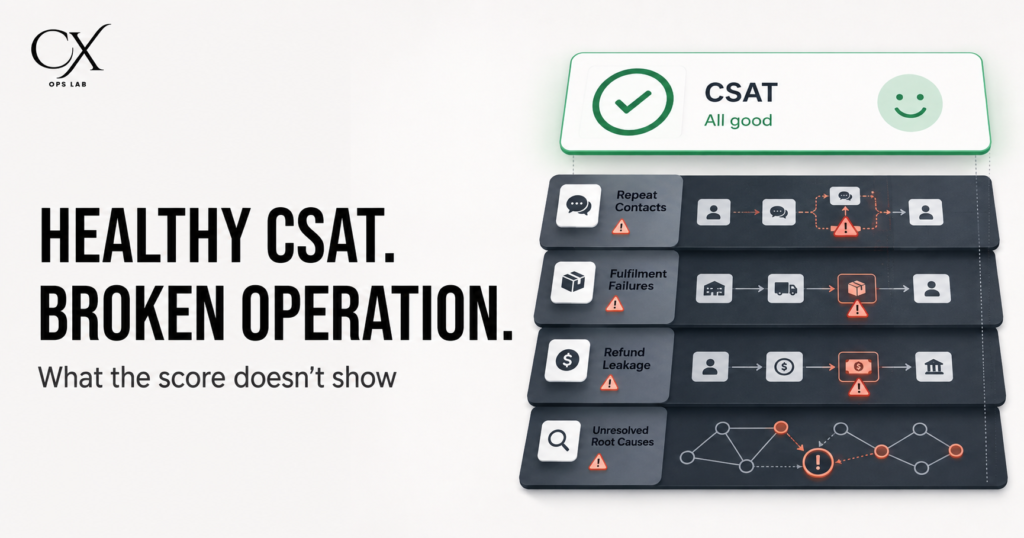
A CX lead pulls up the monthly dashboard. CSAT sits at 91%. The team lead is relieved, the founder is happy, and the slide gets forwarded to the rest of the company as proof that support is doing its job. Three weeks later, refund requests are up, the same fifteen customers have opened a second or third ticket about the same order, and nobody can say why — because the one number everyone was watching told them everything was fine.
This is the trap with CSAT operational metrics: the score measures how a single interaction felt, not whether the underlying problem got fixed. A customer can rate an agent 5 out of 5 for being polite and fast, then contact support again four days later because the actual issue — a wrong item, a stuck refund, a shipping delay nobody flagged upstream — was never resolved. Multiply that across a growing order volume and you get a business that looks calm in the dashboard and increasingly strained everywhere else.
What CSAT actually measures — and what it leaves out
CSAT is a snapshot. It asks one question, right after one interaction: how satisfied were you with this? It says nothing about whether the customer had to contact you at all, whether their issue is now genuinely closed, or whether the same root cause is about to generate five more tickets next week. As IBM notes in its overview of the metric, CSAT doesn’t give a full, ongoing look into customer sentiment or a customer’s long-term relationship with the business — it’s a point-in-time read, not a system-health check.
That gap matters more in ecommerce than almost anywhere else, because ecommerce support tickets are rarely isolated. A late shipment, a mispicked SKU, or an out-of-stock item that wasn’t communicated upstream doesn’t stay contained to one conversation — it tends to resurface as a second contact, a return, or a refund request days or weeks later. None of that shows up in the CSAT number for the original ticket, because that ticket was already closed and rated before the downstream cost appeared.
Operational research on ecommerce support backs this up from the revenue side. As Fairview’s guide to ecommerce customer service metrics puts it, helpdesk-native reporting is limited to what happens inside the helpdesk — it cannot show how CSAT correlates with repeat purchase rate, which customer segments generate the most support volume, or whether return-ticket customers have lower lifetime value. In other words, the score can be accurate and still be blind to the parts of the business it’s supposed to protect.
The four signals CSAT can’t see
A healthy CSAT score and a healthy operation are not the same claim. Here’s where the gap usually opens up.
Repeat customer contacts. If a customer messages you twice about the same order — even if both replies were rated highly — that’s not two satisfied interactions. That’s one unresolved problem, counted twice as a win. Tracking repeat contact rate by order ID and issue type is the fastest way to see what CSAT is masking. If you haven’t built that view yet, our Solo CX Ops System breakdown covers how to structure that tracking without adding headcount.
Fulfilment failures. A wrong item, a damaged package, or a missed delivery window often gets a polite, well-rated first response — “thank you for your patience, replacement is on the way” — while the actual cause, usually somewhere in picking, packing, or courier handoff, goes unlogged. CSAT rewards the tone of the recovery. It has no mechanism for flagging that the same fulfilment error is about to happen to the next fifty orders.
Refund leakage. Refunds approved out of convenience, without a documented reason code or a check against return policy, tend to correlate with CSAT scores that look completely normal — the customer is satisfied, after all, they got their money back with minimal friction. But a support team optimizing for satisfaction scores alone has an incentive to approve refunds quickly rather than correctly, and that incentive quietly erodes margin. This is the exact reason refund rate has to be tracked as a control metric, not an afterthought: across a full nine-month operational period spanning 9,025 orders and roughly $610,000 USD in gross sales, refund rate held at 1.71% — a figure that only means something because it was tracked alongside resolution quality, not instead of it.
Unresolved root causes. This is the umbrella problem. CSAT measures the interaction. It was never built to measure whether the thing that caused the interaction got fixed. A support team can post excellent scores for months while the actual defect, process gap, or handoff failure behind those tickets stays completely unaddressed — because nobody’s dashboard is set up to ask that question.
A simple framework: pairing CSAT with operational signals
The fix isn’t to abandon CSAT. It’s still a useful read on interaction quality. The fix is refusing to let it stand alone as the health metric for the operation. A more honest view pairs CSAT with four operational counterweights, reviewed on the same cadence:
| Signal | What it reveals that CSAT can’t | Review cadence |
|---|---|---|
| Repeat contact rate (by order ID, reason, root cause) | Whether the underlying issue was actually closed | Weekly |
| Escalation closure rate | Whether hard cases get resolved, not just deflected | Weekly |
| Refund rate with reason codes | Whether “satisfied” outcomes are costing margin | Monthly |
| Fulfilment error recurrence | Whether the same operational fault keeps generating tickets | Monthly |
None of these four requires new software. They require a decision to track order ID, issue category, and root cause every time a ticket closes — not just a satisfaction rating. Escalation handling deserves particular attention here, since it’s where CSAT is often most misleading: a well-managed escalation can still score a 5 from a relieved customer even when it exposed a process failure that will recur. Our breakdown of escalation management goes into how ownership and root-cause logging should work at that stage specifically.
Once these four signals sit next to CSAT instead of behind it, the picture usually changes. A team might discover that a 90%+ CSAT score is being generated by the same twenty customers rating three separate contacts each — which is a repeat-contact problem wearing a satisfaction score as a disguise. Or that refund approvals cluster around a specific SKU or supplier, which CSAT alone would never surface because each individual refund conversation went smoothly.
Why this matters more as order volume grows
At low volume, a support lead can hold the full picture in their head — they remember which customers keep coming back, which SKUs cause problems, which refunds felt off. That informal tracking breaks down quietly as volume increases, usually right around the point where a single person is handling everything across two or three sales channels at once. CSAT keeps reporting cleanly because it’s measuring something narrow and stable — how each interaction felt — while the operational load underneath it compounds without anyone noticing until refund rate, repeat contacts, or escalation backlog forces the issue.
This is precisely the blind spot a professional operations review is built to catch. A CSAT score in isolation cannot tell you whether your refund approvals are consistent, whether your fulfilment errors are recurring from the same source, or whether your escalation process actually closes root causes instead of just closing tickets. Those require looking at the operation as a connected system, not a single satisfaction average.
If you can see the gap between your CSAT score and what’s actually happening operationally, that’s worth a closer look. The Professional Operations Health Check is built for CX leads and ops managers who can already name where the pressure is — it scores your current setup against the same operational categories covered here, and gives you the option to request a complimentary 30-minute Operations Review once you’ve completed it. Reviews are limited and assessed for operational fit, not automatically booked.
Building the habit, not just the dashboard
None of this requires replacing your CSAT tool or overhauling your support stack. It requires a habit change: every time a ticket closes, log the order ID, the issue category, and whether this is a repeat contact for the same root cause. Review refund reasons monthly instead of approving on convenience. Track fulfilment errors by source, not just by complaint volume. Within a few weeks, the operational picture next to CSAT starts telling a different — and more useful — story than the score alone ever could.
A high CSAT score is not a false signal. It’s an incomplete one. Treating it as the whole picture is what lets repeat contacts, fulfilment failures, and refund leakage build up quietly behind a number that keeps looking fine.
Ready to see what your CSAT score isn’t telling you? Take the Professional Operations Health Check — it’s built specifically for CX leads and ops managers who need to look past interaction sentiment and into the operational signals underneath it. A complimentary 30-minute Operations Review is available afterward for requests assessed as a strong operational fit.
About CX Ops Lab
CX Ops Lab publishes operational frameworks, SOP templates, and case-study content built from real DTC ecommerce operations — not theory. Every framework was pressure-tested during live operational conditions across Shopify, Shopee, and Lazada at $610,000+ USD GMV scale.
Website: cxopslab.io │ Products: payhip.com/CXOpsLab