
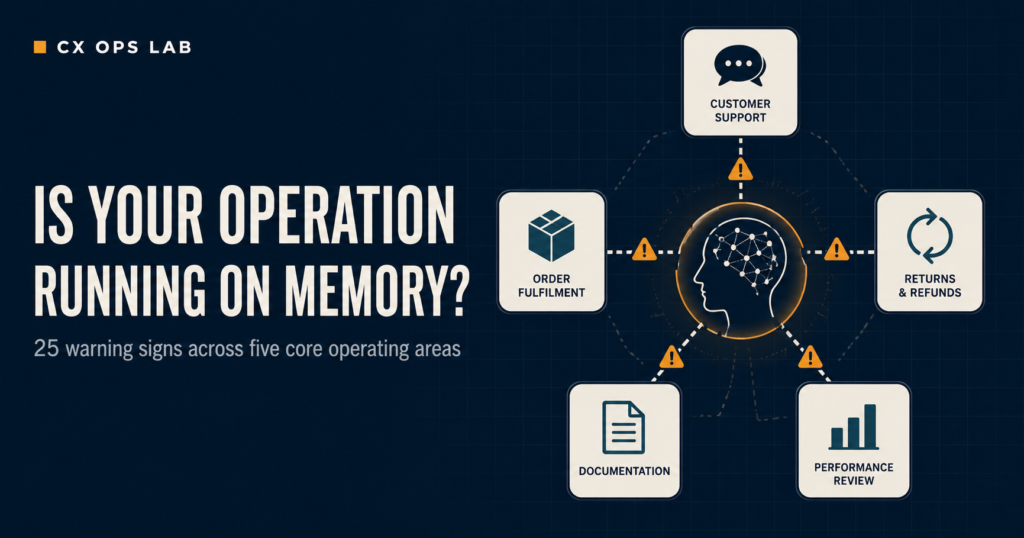
Your fulfillment lead takes a week off and nobody can find where returns actually get logged. Support answers a refund question one way on Monday and a different way on Thursday, depending on who is on shift. The founder still gets pinged directly whenever a Shopee order goes missing, because that is simply how it has always been handled. None of this shows up as one dramatic failure. It shows up as slow, quiet revenue leakage: a refund approved that should not have been, a repeat customer who stops ordering after a second inconsistent answer, a shipment that sits two extra days because the one person who knew the workaround was offline. An ecommerce operations audit exists to catch this pattern before a bigger disruption forces the discovery on its own terms.
Why “We’re Just Busy” Isn’t the Real Problem
Most founders describe the problem as being too busy. That framing hides what is actually happening. Being busy is a symptom. The root cause is that the operation depends on a small number of people remembering the right sequence of steps, the right exception rules and the right person to loop in, instead of a documented system that produces the same outcome regardless of who is working that day.
This is easiest to see at the handoff points. A warehouse team flags a delayed shipment, but there is no fixed rule for when support gets told, so customers sometimes find out from a tracking page before anyone internally does. A refund request above a certain value needs sign-off, but the approval sits in a personal chat thread rather than a workflow, so it either stalls for two days or gets approved by whoever answers first, with no consistent threshold. A returned item arrives at the warehouse and someone decides on the spot whether it goes back into inventory, without a recorded reason code, so the same defect keeps resurfacing without ever getting flagged as a pattern.
There is a specific reason memory-based operations feel fine right up until they are not. When order volume is low, one person can genuinely hold the whole system in their head and outperform a documented process, because there is no coordination overhead. The failure point is not a specific order count. It is the first week that person is sick, on a supplier trip, or simply overwhelmed by two problems landing at once. That is when a customer gets two different refund answers, a delayed shipment goes unflagged for three extra days, or a returned item gets restocked without anyone checking whether it was actually defective. The operation was never actually stable. It was dependent, and dependency does not show up on a dashboard until the dependency breaks.
None of these gaps look urgent individually. Together, they mean the business cannot reliably answer basic questions: how many refunds happened for the same underlying reason last month, how long approvals actually take on average, which handoff is most often the source of a customer complaint. Research on small ecommerce operators has found that many keep core processes undocumented simply because writing them down feels like a luxury when the day is already full of orders to get out the door, according to Flowster. That instinct is understandable, and it is also the exact condition an ecommerce operations audit is built to interrupt.
The Five Areas an Ecommerce Operations Audit Actually Checks
A useful ecommerce operations audit does not chase every possible metric. It checks five areas where memory-based operations tend to break first.
1. Order and fulfillment visibility
This area asks whether anyone besides the founder or warehouse lead can see order status, delays and exceptions without asking someone directly. A “Partially” answer here tends to look like:
- Delays are tracked in someone’s head or a personal spreadsheet, not a shared system
- Support finds out about a stockout from a customer instead of from operations
- There is no fixed rule for who updates a customer once a shipment passes a set delay threshold
- Expedited or manual orders bypass normal tracking entirely
- Nobody can pull last month’s on-time fulfillment rate without checking multiple tools by hand
2. Customer communication and response consistency
This checks whether two different customers with the same issue get the same answer. A “Partially” answer here tends to look like:
- Refund and replacement decisions vary depending on which staff member responds
- There is no shared reply template for common issues like delays or defects
- Response time is inconsistent across channels, so a comment gets answered faster than an email
- Escalations sometimes reach the founder directly instead of following a set path
- Nobody reviews closed tickets to check whether the resolution actually matched policy
3. Returns and refund control
This is where inconsistent judgment calls quietly cost the most money. A “Partially” answer here tends to look like:
- Refund approval thresholds are not written down anywhere staff can reference
- Returned items are restocked or discarded based on individual judgment, not a recorded reason code
- Refund turnaround time is not tracked, so nobody knows if it is getting slower
- There is no routine check for repeat refund requests tied to the same product or batch
- Refund data is not reviewed for patterns that would point to a fixable root cause
4. Inventory and stock accuracy
This measures whether the number in the system matches the number on the shelf, and whether anyone would notice quickly if it did not. A “Partially” answer here tends to look like:
- Stock counts across marketplaces are reconciled manually and irregularly
- A stockout is discovered when a customer complains rather than through an internal alert
- There is no standard message sent to customers waiting on backordered items
- Safety stock levels are set from memory rather than from sales velocity
- Nobody owns the task of correcting listings after a stock discrepancy is found
5. Documentation and process ownership
This area determines whether the other four can survive one person being unavailable. A “Partially” answer here tends to look like:
- Core processes exist only as verbal knowledge held by one or two people
- There is no written SOP for the tasks that happen every single day
- A new hire needs direct shadowing to learn the refund or escalation process, because nothing is written down
- Existing process documents have not been updated since the business changed platforms or scaled
- No one is assigned to keep documentation current as the operation grows
Take the Free Ecommerce Operations Health Check
Most solo operators and small teams score “Partially” across at least three of these five areas at once, because the areas are connected. A missing reason code in returns shows up later as an inconsistent refund decision. A fulfillment delay that nobody flagged shows up later as a support ticket with no context. Take the free 25-question Ecommerce Operations Health Check. It takes about five minutes and shows which operating area needs attention first.
A Simple Way to Self-Score Before You Take the Full Audit
You do not need the complete assessment to get a first read on where the gaps are. For each of the five areas above, rate your operation honestly on a three-point scale: Yes, it is written down and anyone on the team could follow it without asking; Partially, it works but depends on one person’s memory or judgment; No, it is not consistent and varies by whoever handles it that day. An operation with two or more “No” ratings across the five areas is usually losing money in ways that do not show up cleanly on a P&L, because the cost is spread across refund leakage, slower resolution and repeat contacts rather than one visible line item.
This pattern held true across nine months of running a real solo DTC operation across Shopify, Shopee and Lazada, covering 9,025 orders and approximately $610,000 USD in gross sales. The areas that were documented early, particularly returns handling and escalation routing, held a 1.71% refund rate and a 95.1% escalation closure rate even during a serious product quality incident that touched all three platforms at once. The areas that were still running on memory were the ones that slowed down first whenever volume spiked or the wrong person was unavailable. An operations audit is not about proving the business is broken. It is about finding which two or three areas would produce the fastest improvement if they were fixed first — the same question a written return and refund process, like the one in the ecommerce SOP template, is built to answer. For a broader look at how one person can run all five areas without a full team, see the solo CX ops system.
What an Operations Audit Is Not
It helps to be precise about what an operations audit is not. It is not a customer satisfaction survey, and a high CSAT score does not mean these five areas are healthy — a customer can rate an interaction positively while the underlying process that produced it stays undocumented and inconsistent for the next person who handles a similar case. It is also not a one-time exercise. Platforms change, order volume grows, and a process that worked at a few hundred orders a month often breaks quietly once volume triples, because the informal workaround that used to cover the gap stops scaling. Revisiting the same five areas every quarter, even briefly, catches the drift before it turns into a repeat of the same customer complaint on a different product line.
The other thing worth naming directly: documenting a process is not the same as slowing the business down. A written refund threshold, a standard delay-notification message and a recorded reason code for returns all take less time to execute than a judgment call made from scratch every time, once they exist. The upfront cost is real but small. The ongoing cost of not having them shows up every time a new hire needs shadowing to learn a task that should take five minutes to read, or every time two team members give a customer contradictory information because neither one had anything to check against.
Where to Start
Once the five areas are scored, the next step is not to fix all of them simultaneously. Most solo operators and lean teams get better results by picking the one area with the most “No” ratings and writing a single-page process for it before touching anything else: who owns the decision, what the default rule is, when an exception needs a second opinion, and where the outcome gets logged. That single document usually resolves the most visible customer-facing symptom within a few weeks, which is also the fastest way to prove the audit was worth doing before investing time in the other four areas.
Take the Next Step
An ecommerce operations audit will not fix anything by itself. What it does is turn a vague sense that “things are messy” into a specific, ranked list of what to document first. Take the free 25-question Ecommerce Operations Health Check. It takes about five minutes and shows which operating area needs attention first.
About CX Ops Lab
CX Ops Lab publishes operational frameworks, SOP templates, and case-study content built from real DTC ecommerce operations — not theory. Every framework was pressure-tested during live operational conditions across Shopify, Shopee, and Lazada at $610,000+ USD GMV scale.
Website: cxopslab.io │ Products: payhip.com/CXOpsLab
Pingback: Ecommerce Operations Review: What to Prepare for a Useful 30-Minute Diagnostic Call