
A founder finishes the Professional Operations Health Check, gets a score, and books the complimentary review because the number feels lower than it should. Fifteen minutes into the call, most of the time has gone to background: what the business sells, how long it’s been running, which platform breaks the most often. The actual diagnostic conversation — the part that changes what happens next — gets compressed into the last five minutes, and the call ends with a vague promise to “think about priorities” rather than a decision.
An ecommerce operations review works the same way any diagnostic works: the output is only as sharp as the input. A doctor can’t do much with “I don’t feel great.” An ops reviewer can’t do much with “things feel messy.” The businesses that get a genuinely useful 30 minutes are the ones that show up with a specific score, a specific pressure point, and a specific decision they’re trying to make. This article covers exactly what that looks like, so the call produces a plan instead of a summary of what you already knew.
Why Most 30-Minute Reviews Underdeliver
The complimentary review is short by design. Thirty minutes is enough time to confirm a diagnosis, rank priorities, and agree on a next step — it is not enough time to also gather the facts that should have arrived before the call started. When a request comes in with no context beyond “my score was low,” the reviewer has to spend the first half of the session doing discovery work that the requester was better positioned to do in five quiet minutes at their own desk.
This is the same failure pattern that shows up in any short-form diagnostic conversation, whether it’s a doctor’s appointment or a business consulting call: the session works when the person being assessed arrives with symptoms already organized, and it stalls when the practitioner has to extract that information live.
Structured discovery frameworks make the same point from the sales side: a session that spends its early minutes diagnosing the real problem, instead of general small talk, is far more likely to end in a concrete next step than one that drifts. One breakdown of effective discovery calls frames it plainly: run it like an appointment with an agenda, not an open-ended chat.
The Ecommerce Operations Health Check series was built to solve exactly this handoff problem. A quick sense of the intent behind the assessments — and how a low score is meant to start a conversation rather than end one — is covered in
The free health check exists for exactly this reason: it’s the fastest way to see which of the 25 warning signs apply before requesting anything more formal. That context is covered in Ecommerce Operations Audit: 25 Warning Signs Your DTC Operation Is Running on Memory, which is worth reading first if you haven’t completed either assessment yet.
What an Ecommerce Operations Review Actually Assesses
The review is not a sales pitch dressed up as a call, and it is not a free consulting engagement. It’s a structured conversation built around the Professional Operations Health Check score: a 25-question, 100-point assessment covering support workflow, fulfilment coordination, refund control and escalation handling. The reviewer’s job in those 30 minutes is to confirm what the score is already suggesting, pressure-test it against real examples, and help the requester decide what to fix first.
Because slots are limited, requests are assessed for operational fit before a call is confirmed. A request with a completed score, a named pressure area and a couple of concrete examples is easy to evaluate quickly. A request that says only “can we talk” is not — and it’s more likely to sit in the queue while better-prepared requests move ahead. None of this is a formality. It’s the same reason a specialist’s office asks for symptoms before booking an appointment: the prep determines whether the time gets used well.
The Six-Part Prep Framework for a Useful Ecommerce Operations Review
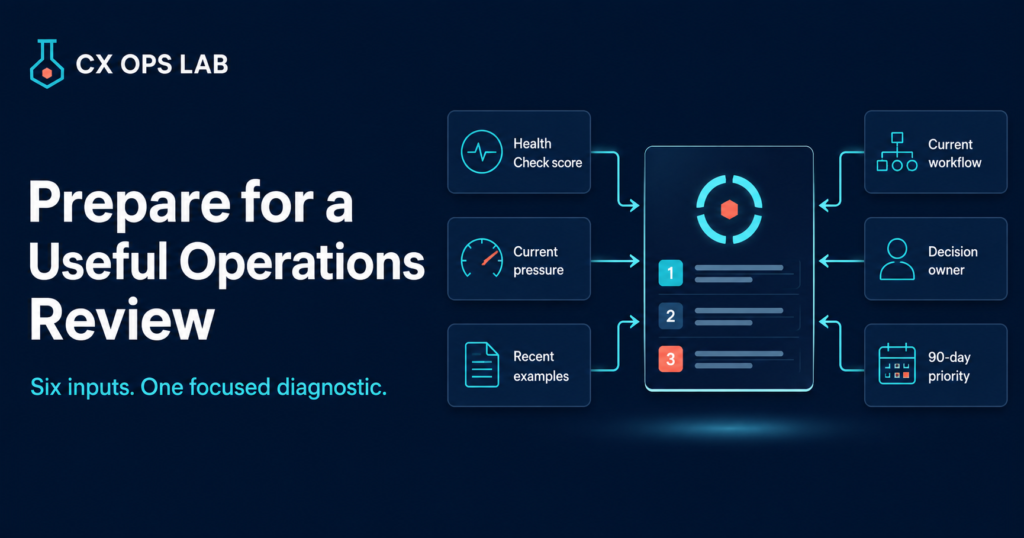
Before requesting the review, gather these six things. None of them require new tools or a data project — most operators can pull this together from memory and their existing dashboards in under twenty minutes.
1. Your score and the section breakdown
Have your Professional Operations Health Check score on hand, along with which of the four scored areas — support workflow, fulfilment coordination, refund control, escalation handling — pulled the number down. A total score tells the reviewer how much risk exists; the section breakdown tells them where it’s concentrated. Arriving with only the headline number forces the call to start with questions you already have the answers to.
2. Your single biggest operational pressure
Every operation has more than one weak spot, but only one of them is usually costing real money or time right now. Name it specifically: “refunds take too long to approve,” not “customer service needs work.” A vague pressure point produces a vague conversation. A specific one lets the reviewer go straight to the mechanism behind it.
3. Two or three recent, concrete examples
Bring real situations, not categories. “A customer waited six days for a refund decision because the return had to be manually matched to the original order” tells the reviewer more in one sentence than a general complaint about slow refunds. You don’t need company names, batch numbers or customer details — the operational sequence is what matters, not the identifying information around it.
4. How the workflow currently runs, in plain terms
Describe the process as it actually happens today, including the parts that are informal or inconsistent. Who receives the request first? Who has authority to approve an exception? Is there a shared document, a spreadsheet, or is it tracked in someone’s head? Reviewers can’t diagnose a workflow gap they can’t see — and most gaps only become visible once the current process is described step by step rather than summarized as “we handle it case by case.”
5. Who owns the decision to implement changes
If you’re not the person who can approve a new SOP, reassign a task, or authorize a purchase, say so upfront and bring that person onto the call if possible. A review that produces a clear recommendation nobody is positioned to act on is a wasted 30 minutes for everyone. This is especially relevant for solo operators bringing in a part-time contractor or a co-founder — clarify in advance who is actually making the call.
6. Your 90-day priority
Come with an honest answer to “what do you want fixed by the end of this quarter?” It doesn’t need to be the technically correct priority — that’s part of what the review is for. But an explicit starting priority gives the reviewer something concrete to validate, adjust or redirect, instead of guessing at what matters most to your business right now.
Reviewers who work through KPI-level conversations regularly see the same handful of metrics come up as the fastest way to make a pressure point concrete — repeat contact rate, escalation closure, refund cycle time. If you want a head start on turning “things feel messy” into numbers before the call,
Ecommerce Operations KPI Dashboard: 12 Metrics That Connect Support Work to Revenue Risk walks through the metrics worth pulling first. See it here: cxopslab.io/ecommerce-operations-kpi-dashboard.
| Haven’t completed the Professional Operations Health Check yet?Take the 25-question Professional Operations Health Check to get your score and section breakdown. Once you have it, you can request a complimentary 30-minute Operations Review — requests are limited and assessed for operational fit, so completing the assessment first is the fastest way to get a useful call. Start the Professional Operations Health Check |
What Happens During the 30-Minute Call
The structure is straightforward. The first few minutes confirm the score and section breakdown against the examples you’ve brought — this is where a well-prepared request saves the most time, since there’s no need to reconstruct the situation from scratch. The middle stretch is spent testing whether your named pressure point is actually the root cause or a downstream symptom of something else, which is often the most useful part of the call for operators who’ve been treating a workflow gap as a staffing problem, or the reverse.
The last few minutes are for prioritization: given your 90-day priority, the decision owner in the room, and what the review has surfaced, what’s the one change worth making first. Sometimes that’s a self-serve fix using an existing framework. Sometimes it’s a workflow adjustment that doesn’t require any purchase at all. The review is not structured to end in a hard sell — it’s structured to end in a decision you can act on Monday morning.
It’s worth setting expectations accurately here: the complimentary review is optional, limited in availability, and every request is assessed for operational fit before a slot is confirmed. Submitting a request is not the same as booking a call, and not every request will be a fit for a 30-minute diagnostic format — some situations are better served by a self-serve product or a fuller assessment first.
After the Call: Turning a Diagnosis Into a 90-Day Plan
A review is a starting point, not a finished plan. Founders who get the most from their 30 minutes tend to convert the priority discussed on the call into a phased plan almost immediately, while the specifics are still fresh — stabilizing the most urgent gap in the first month, standardizing the fix so it doesn’t regress, then measuring whether it actually held. If you completed the health check and want a structured way to sequence what comes next once you have your score and your priority, that phased approach is the natural follow-on step after the review itself.
Request Your Ecommerce Operations Review
If you’ve completed the Professional Operations Health Check and can name your score, your section breakdown, your top pressure area and a couple of recent examples, you have what a useful review needs. Bring the decision owner if that’s not you, and come with an honest 90-day priority rather than a polished one.
| Request Your Complimentary Operations ReviewComplete the Professional Operations Health Check and request your complimentary 30-minute Operations Review. Requests are limited and assessed for operational fit — arrive with your score, your top pressure and one clear priority, and the call will earn its 30 minutes. Take the Professional Operations Health Check |
About CX Ops Lab
CX Ops Lab publishes operational frameworks, SOP templates, and case-study content built from real DTC ecommerce operations — not theory. Every framework was pressure-tested during live operational conditions across Shopify, Shopee, and Lazada at $610,000+ USD GMV scale.
Website: cxopslab.io │ Products: payhip.com/CXOpsLab