
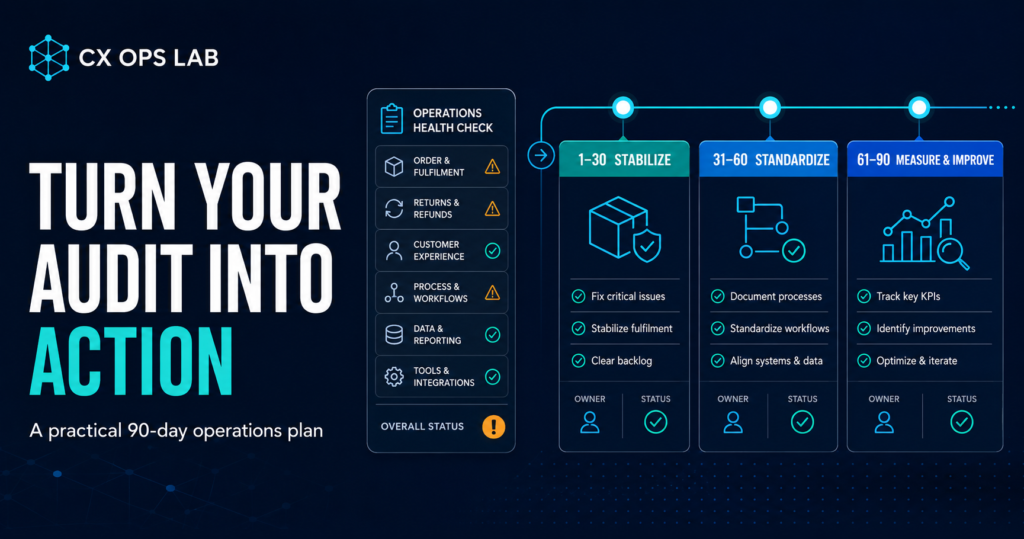
Most operators finish a health check, look at the score, feel a mix of relief and dread, and then go back to whatever was on fire that morning. Three weeks later the PDF is still open in a browser tab nobody has closed, and the same five problems are still generating the same customer complaints. A score by itself does not fix anything. What turns a 90 day ecommerce operations plan from a good intention into an actual result is sequencing — deciding what gets touched in the first month, what gets built in the second, and what finally gets measured in the third.
This matters because the gap between “we know what’s wrong” and “we fixed it” is where most ecommerce operations improve or stall. A founder or ops manager who has just completed an audit is standing in exactly the right place to build that sequence — but only if the plan gets written down before the urgency fades and the findings quietly become background noise.
Why a Completed Health Check Rarely Turns Into Action
The health check does its job. It surfaces where refund approval is inconsistent, where warehouse updates lag behind what support tells customers, where nobody owns fulfilment error tracking, or where a handful of recurring complaints keep draining time without ever being logged as a pattern. The problem isn’t the diagnosis. The problem is that a list of 15 or 20 gaps, sitting next to a full workload, looks like more work than the operator already can’t keep up with — so nothing on the list gets picked first, and the list itself becomes the next thing that gets postponed.
There’s also a structural reason plans stall: most audit results are organized by category — support, fulfilment, refunds, communication — not by urgency. Category order is useful for diagnosis. It is close to useless for deciding what to fix in week one. An operator staring at five categories of roughly equal severity has no natural next step, and without a forced sequence, the easiest item usually wins, even when it isn’t the one costing the most revenue or trust.
The Three-Horizon Structure Behind a Working 90 Day Ecommerce Operations Plan
A 90 day ecommerce operations plan works when each horizon has a different job. Days 1–30 are for stopping active bleeding. Days 31–60 are for turning fixes into something repeatable. Days 61–90 are for checking whether any of it actually moved a number. Trying to do all three at once is how audits turn into abandoned spreadsheets.
Days 1–30 — Stabilize
The first month is not about building new systems. It’s about closing the gaps that are actively costing money or trust right now — the refund decision that took nine days because nobody had approval authority, the warehouse update that never reached the support inbox, the complaint category nobody is tracking because it doesn’t have a name yet. Pick three to five items, not fifteen. Each one should have a named owner and a date, not a shared intention. If an item can’t be assigned to one person by day three, it isn’t a stabilize-phase item — it’s a standardize-phase item wearing a disguise.
Days 31–60 — Standardize
Once the immediate leaks are closed, the second month is where a fix becomes a system. This is the difference between “I personally caught that refund exception” and “there’s now an approval matrix that tells anyone what to do with that exception.” Standardizing means writing the SOP, defining the handoff, setting the escalation trigger, and making sure the fix survives the operator taking a day off. Teams that skip this phase tend to see the same problem resurface within a quarter, because the original fix depended on one person remembering to do it.
Days 61–90 — Measure and Improve
The final month answers one question: did any of this change the numbers that matter? Refund cycle time, repeat contact rate, escalation closure, fulfilment error recurrence — whichever metrics the original health check flagged as weak points. This phase isn’t about adding new fixes. It’s about confirming the first two months earned their time, and about identifying the one or two items that still need another pass. A plan that skips measurement isn’t really a plan; it’s a set of good intentions with a calendar attached.
A Simple Way to Decide What Gets Fixed First
Not every gap from a health check deserves the same urgency. A useful filter runs each item through three questions before it gets a slot on the calendar.
Customer impact — does this gap change what a customer experiences directly, or is it an internal inefficiency that customers never see? A refund approval delay a customer feels every time is a different priority than a reporting gap only the operator notices.
Revenue exposure — is this gap connected to lost sales, refund leakage, or chargebacks, or is it mostly a time cost? A fulfilment error that triggers a refund and a support ticket carries more weight than a slow internal note-taking habit.
Recurrence — is this a one-off or does it happen every week? A problem that surfaces daily deserves a stabilize-phase slot even if each individual instance is small, because the compounding cost is what actually shows up in the numbers.
Score each open item loosely across these three factors — high, medium, or low is enough precision for this stage — and the highest-scoring items become the first month’s short list almost by default. This isn’t a scientific model. It’s a way to stop debating priority in the abstract and start acting on the items most likely to move revenue or trust in the next thirty days.
A 90-Day Plan at a Glance
Once items are scored, they tend to sort themselves into a shape close to this:
Days 1–30, Stabilize — 3–5 items, each with a named owner and a fixed date. Typical examples: closing an unowned refund exception, syncing a warehouse delay with the support inbox, logging a complaint pattern that has never been tracked.
Days 31–60, Standardize — the same items, now written as an SOP, an approval matrix, or a defined handoff, so the fix doesn’t depend on one person’s memory. This is also where any documentation gaps the health check flagged should be closed.
Days 61–90, Measure and improve — the specific metrics tied back to each stabilized item — refund cycle time, repeat contact rate, escalation closure, error recurrence — reviewed against where they stood before day one, with one or two remaining gaps carried into the next cycle rather than abandoned.
Keeping the list this short is intentional. A plan with thirty action items across three months isn’t a plan — it’s the same overwhelming list from the health check, just stretched over a longer calendar.
Common Mistakes That Restart the Clock
A few patterns show up often enough to name directly. The first is treating every finding as urgent, which collapses the three horizons back into one undifferentiated pile and guarantees nothing gets finished properly. The second is skipping the standardize phase because the stabilize-phase fix “seems to be holding,” which works until the person who made the fix is unavailable and the old problem reappears exactly as it was. The third is measuring too early — checking results in week three instead of week ninety — which produces noisy numbers and an unfair verdict on a plan that hasn’t had time to work.
The fourth, and the one that quietly does the most damage, is letting the plan live only in someone’s head. A sequence that isn’t written down with owners and dates attached tends to compress under the next crisis, and the next one after that, until the 90-day window closes with the same open items it started with — just with more time and credibility spent.
| Ready to move from diagnosis to a working plan?By this point the gap between having a health check score and having a working plan is usually clear: the score tells you where the weak points are, but sequencing, ownership and measurement are what actually close them. If turning your results into a working 90-day plan feels like more than a solo build, the Professional Operations Health Check goes further than the free version and is the entry point for the complimentary 30-minute Operations Review. Requests are complimentary, limited, and assessed for operational fit — not an automatic booking.Take the Professional Operations Health Check → |
What Happens When the Plan Has No Owner
The most common failure mode isn’t a bad plan — it’s a plan with no single owner. When a 90-day plan is “the team’s” responsibility, it tends to belong to whoever has the least on their plate that week, which in most small ecommerce operations is nobody. A workable plan names one person accountable for the sequence overall, even if individual items are delegated. That person’s job isn’t to do every fix personally — it’s to make sure the calendar holds, the stabilize-phase items don’t slide into month two, and the measurement step actually happens instead of getting quietly skipped because the numbers might not look great.
This is also where internal operational data becomes useful as a benchmark, not just a talking point. Across a real multi-platform DTC operation processing 9,025 orders over nine months — roughly $610,000 USD in gross sales — the operations that held up under pressure weren’t the ones with the most sophisticated systems. They were the ones with a 1.71% refund rate and a 95.1% escalation closure rate because someone owned the sequence end to end, reviewed it weekly, and didn’t let stabilize-phase fixes drift past their deadline. The structure matters more than the sophistication.
Building an SOP Layer Under Each Fix
A stabilize-phase fix that never gets written down disappears the moment the person who made it gets busy, changes roles, or takes leave. This is where a documented SOP layer earns its keep — not as paperwork, but as the thing that lets a fix survive contact with a normal, chaotic week. If your health check flagged documentation gaps specifically, it’s worth treating SOP creation as its own line item inside the standardize phase rather than assuming it will happen automatically once the fix is “done.”
Turning the Plan Into a Review-Ready Case
Operators who go through this sequence properly end up with something more useful than a completed checklist — they end up with a case. They can describe where they started, what they fixed first and why, what became a system instead of a one-off save, and what the numbers did as a result. That case is exactly what makes a conversation with someone outside the business — an advisor, an investor, a potential hire, or a reviewer — actually productive, instead of a vague “things have been busy” update.
If you’ve already run the free health check and want the plan itself reviewed rather than just the diagnosis, the Professional Operations Health Check is built for that next step. It captures current pressure, priority and readiness in more depth, and it’s the qualifying path to the complimentary 30-minute Operations Review — a conversation about your specific sequence, not a generic sales call. Requests are complimentary, limited, and assessed for operational fit before scheduling.
| Take the Professional Operations Health Checkhttps://cxopslab.io/professional-operations-health-check/ |
Related reading: if the standardize phase of your plan involves writing documentation from scratch, the Ecommerce SOP Template breakdown covers the five SOPs most DTC brands are missing before their first real crisis. And if you’re the only person currently running this sequence, the Solo CX Ops System article walks through how a single operator kept a nine-month, 9,025-order operation under control without a team.
Further reading: Ecommerce SOP Template: The 5 Every DTC Brand Needs Before Their First Crisis Hits
Further reading: Solo CX Ops System: What 9,025 Orders Taught Me About Scalable Ecommerce Operations
External reference: BigCommerce — Ecommerce Operations: Optimizing for Success
About CX Ops Lab
CX Ops Lab publishes operational frameworks, SOP templates, and case-study content built from real DTC ecommerce operations — not theory. Every framework was pressure-tested during live operational conditions across Shopify, Shopee, and Lazada at $610,000+ USD GMV scale.
Website: cxopslab.io | Products: payhip.com/CXOpsLab