
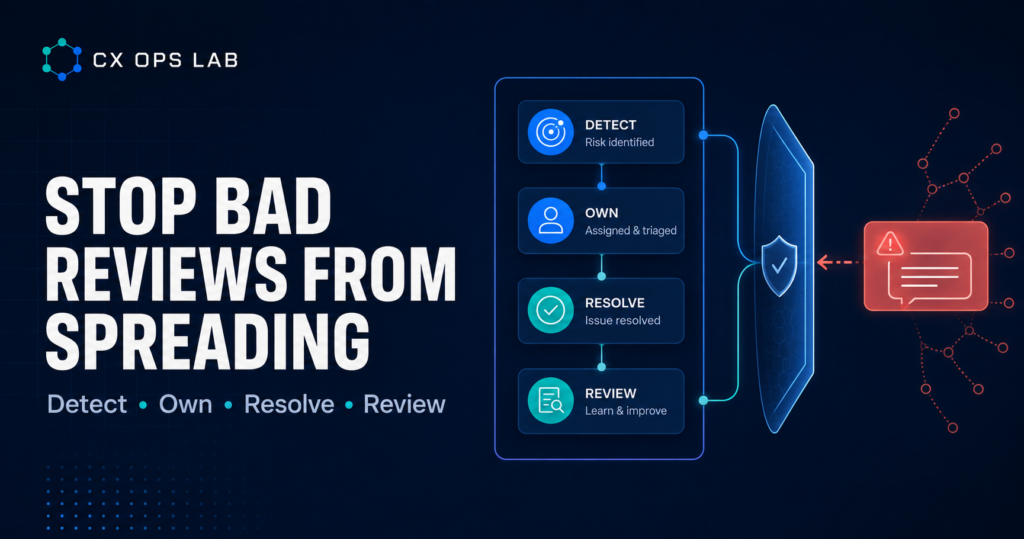
A comment shows up under a paid ad at 9:40 on a Tuesday morning. It names a real order number, describes a product that arrived damaged, and asks — publicly — why nobody replied to three emails. By lunch it has eleven replies of its own, most of them from people who never ordered anything but recognize the shape of being ignored. The ad is still running. The ad budget is still spending. And the first person from the brand to see the comment is whoever happens to open the ads dashboard next.
That gap — between when a complaint goes public and when someone with authority actually responds to it — is where reputation damage compounds. It is rarely the complaint itself that does the damage. It is the visible silence around it, and the improvised, inconsistent response that eventually follows once someone notices.
This article lays out the ecommerce reputation management process that closes that gap: how to detect a public complaint fast, decide how serious it actually is, assign it to someone by name, respond publicly without making promises operations can’t keep, resolve it privately, and review what happened so the same failure doesn’t repeat with the next comment.
Why Most Ecommerce Brands Are Reacting, Not Managing
Ask most DTC founders what happens when a customer complains publicly and the answer is some version of “whoever sees it handles it.” That sounds fine until three things happen at once: a support inbox backlog, a warehouse delay, and a comment on a boosted ad. Now three different people are three different degrees of upset, and none of them were told the same thing.
The underlying problem is not a lack of care. It’s the absence of a system that tells a team, without a meeting, what a given complaint requires: how fast it needs a response, who owns that response, what can be said publicly versus what has to move to a private channel, and what evidence needs to be saved before the thread disappears or gets edited.
Without that system, three failure patterns repeat on a loop:
- A public comment sits unanswered for hours because no one is assigned to monitor the channel it appeared on.
- The eventual reply is written in a rush, admits more than it should, or promises a resolution the operations team hasn’t confirmed.
- Nobody logs what happened, so the same complaint type resurfaces next month with no faster fix than the first time.
What “Fast” Actually Means to the Person Reading Your Reply
Consumer expectations around response speed have moved, and they keep moving. Recent BrightLocal-sourced data reported by Nadernejad Media found that roughly half of consumers now expect a business to respond to a public review or comment within 24 hours, and the share expecting a next-day reply has nearly doubled year over year. Against that expectation, the same research found the average business takes closer to three days to respond — a gap wide enough that most brands are losing the moment before they even start typing.
A separate review of response-rate research from Upfirst puts the scale of the problem in context: only a small fraction of businesses respond to reviews at all, despite the large majority of consumers who say they expect a reply. That gap is not a copywriting problem. It’s an ownership and workflow problem — nobody is assigned to close it.
The Escalation System: Eight Decisions, in Order
An ecommerce reputation management process is not a response template. A template gives you words to use once you’ve already decided the complaint is serious enough to warrant a reply. A process decides that for you, before the words matter — and it applies the same way whether the complaint lands on Shopify order support, a Shopee chat, a Lazada review, or a Facebook ad comment.
The sequence below is the operating structure. It is not the full framework — the complete escalation matrix, evidence log templates and response scripting live in the paid framework linked further down — but it is enough to see where your current setup has a gap.
1. Detection — know within the hour, not the week
Every channel where a customer can complain publicly needs an owner checking it on a fixed schedule: ad comments, marketplace reviews, social mentions, and any public order-status thread. If nobody is assigned to a channel, that channel is where the next unmanaged crisis starts.
2. Severity — not every complaint is the same emergency
A typo in a shipping confirmation and a public accusation of a defective product are not the same risk level, but treated identically they get identical (wrong) response speed. Severity has to be scored on visibility, factual accuracy, and potential for the thread to be shared beyond its original audience — not on how upset the customer sounds.
3. Ownership — a name, not a department
“Support will handle it” is not an assignment. A specific person needs to see their name against the case within the severity-appropriate window, with a clear escalation path if they can’t resolve it alone.
4. Public response — acknowledge, don’t negotiate
The public reply has one job: show that a real person saw this and is handling it, without admitting fault that hasn’t been confirmed, promising a resolution operations hasn’t approved, or arguing with the customer in view of everyone else reading the thread.
5. Private recovery — move the resolution off the public record
Once acknowledged publicly, the actual resolution — refund, replacement, credit, explanation — happens through DM, email, or a support ticket. The public thread stays short and calm; the substantive conversation happens where the details can be worked through properly.
6. Evidence preservation — screenshot before you reply
Comments get deleted, reviews get edited, and platforms occasionally remove content entirely. Before any public reply goes out, capture the original post, the account, the timestamp, and the order reference tied to it. This protects the brand if the story changes later and gives operations something concrete to investigate.
7. Resolution — close the loop with the customer, not just the thread
A resolved case means the customer knows it’s resolved, not just that the public comment stopped appearing in your monitoring feed. Confirm the outcome directly with them before marking the case closed.
8. Post-incident review — find the pattern, not just the fix
Every closed case should answer one question beyond “was it fixed”: would this have happened if the last three similar cases had already changed something upstream? If the same root cause keeps generating new complaints, the fix belongs in the operation, not in the reply template.
A Severity Reference for Sorting Incoming Complaints
Use this as a starting sort, not a finished policy. The exact thresholds should match your order volume, refund exposure and platform mix.
| Signal | Low | Elevated | High |
| Visibility | Private message only | Public comment, low engagement | Public comment gaining replies/shares |
| Claim type | Delay or general dissatisfaction | Product condition or billing dispute | Safety, health, or repeated unresolved contact |
| Response window | Within 24 hours | Within 4–6 hours | Within 1 hour, named owner |
| Who replies | Support agent | Support lead | Ops/founder-level, with evidence log open |
What This Looks Like Run Consistently
Across nine months of solo, cross-platform ecommerce operations spanning Shopify, Shopee and Lazada — 9,025 orders and roughly $610,000 USD in gross sales — escalation cases across all three platforms closed at a 95.1% rate. That number didn’t come from writing better apology messages. It came from applying the same detection-to-review sequence to every case, regardless of which platform it started on, so nothing depended on who happened to be online when the complaint appeared.
A Response Template Is Not an Operating System
Plenty of resources will hand you a script for replying to a bad review. That’s useful for the fifth step in the sequence above and nowhere near sufficient on its own. A script doesn’t tell you which complaints deserve a one-hour response versus a same-day one. It doesn’t assign an owner. It doesn’t preserve evidence, track resolution against a real customer outcome, or feed a pattern back into your operations so the complaint stops recurring. That’s the difference between a reply and a reputation management process — and it’s the gap most public-complaint playbooks leave open.
Already had a public complaint you weren’t fully ready for? The Online Reputation Protection Framework gives you the full severity matrix, response scripting by tier, evidence log template and a weekly risk-review format — built from the same escalation process referenced above.
Related Reading
Two related breakdowns from this operation go deeper on specific pieces of this system:
• How We Contained a Negative Comment on an Active Ad in 4 Hours — a real single-incident walkthrough of the public-response step above.
• The Exact Escalation Workflow That Closed 95.1% of Crisis Cases Across 3 Platforms — the full ownership and closure workflow this article draws its structure from.
Building the System Before You Need It
The brands that handle public complaints well are not the ones with the best apology writers. They’re the ones who decided, in advance and while things were calm, who owns which channel, how fast a reply has to go out, and what gets escalated versus what a support agent can close alone. Write that system once and every future complaint gets handled by the process instead of by whoever happens to be paying attention that day.
Get the full escalation system: The Online Reputation Protection Framework ($29) includes the complete severity matrix, ownership assignment templates, public and private response scripting by tier, an evidence log, and a weekly risk-trend review format you can put in place before your next public complaint — not during it.
About CX Ops Lab
CX Ops Lab publishes operational frameworks, SOP templates, and case-study content built from real DTC ecommerce operations — not theory. Every framework was pressure-tested during live operational conditions across Shopify, Shopee, and Lazada at $610,000+ USD GMV scale.
Website: cxopslab.io │ Products: payhip.com/CXOpsLab