
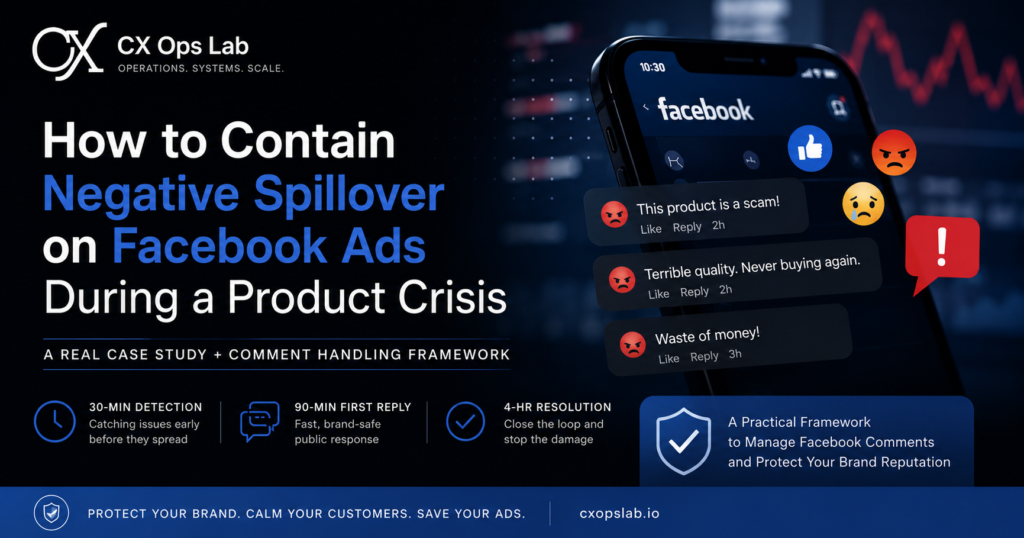
A Facebook ad comment crisis rarely announces itself. It starts as a single comment — sometimes with a photo attached, sometimes just three angry sentences — sitting underneath an ad that is actively delivering to a cold audience of people who have never heard of your brand before. Handled well, a Facebook ad comment crisis is contained within hours and forgotten by next week. Handled poorly, it becomes the first thing new visitors see, right before they decide whether to trust you with their money.
This is the exact workflow we used to detect, contain, and resolve a Facebook ad comment crisis in under four hours — without pausing the ad, without losing campaign momentum, and without losing the customer.
What Counts as a Facebook Ad Comment Crisis
Not every comment on an ad is a Facebook ad comment crisis. Most comments are questions, price objections, or the occasional troll — noise that a normal reply clears in minutes. A genuine Facebook ad comment crisis has a specific signature:
- The ad is actively delivering — meaning cold, unfamiliar audiences are seeing the thread in real time
- The comment includes photo or video evidence of a real product issue
- The complaint is detailed enough to read as credible rather than vague venting
- A reply thread is starting to form underneath it
If two or more of these show up on a live ad, you are looking at a genuine Facebook ad comment crisis — not routine feedback that can wait for the next support shift.
Why a Facebook Ad Comment Crisis Behaves Differently Than a Normal Complaint
A normal customer complaint arrives privately in your inbox, invisible to anyone else. A Facebook ad comment crisis arrives in public, underneath a paid message you are actively paying to put in front of strangers, at the exact moment they are deciding whether to click “Add to Cart.”
Three things make this different operationally:
- Cold audience exposure — people with zero brand context see the complaint before they see anything positive about you
- Algorithmic signal risk — platforms read a negative, unanswered comment thread as a quality signal, which can affect delivery
- Compounding visibility — an unresolved thread invites more comments, turning one complaint into a pile-on
Why This Matters More Than a RefundA single unresolved comment on an active ad can suppress click-through and reduce conversion in a similar way to a visible 1-star review — anywhere from the high single digits up to 25%+ depending on your traffic volume and how long the thread stays visible. A Facebook ad comment crisis is rarely a refund problem. It’s a conversion-rate problem wearing a customer service costume.
The Facebook Ad Comment Crisis Response Workflow
Every Facebook ad comment crisis we’ve handled follows the same eight-step workflow, whether it’s a single angry comment or a fast-forming thread:
| Step | Action | Owner | Timeline |
|---|---|---|---|
| 1 | Comment identified on active ad | Social monitoring / CS | Real-time |
| 2 | Severity assessed: complaint type, evidence, engagement level | CS Lead | Within 15 min |
| 3 | Public reply posted: acknowledgment + invitation to DM | CS Team | Within 2 hours |
| 4 | Personalized direct message sent to the commenter | CS Lead | Within 2 hours |
| 5 | Case flagged internally if unresolved or escalating | CS Lead | Immediately |
| 6 | Resolution offered per standard replacement/refund SOP | CS Team | Per case SLA |
| 7 | Comment hidden once private resolution is confirmed | CS Lead | After confirmation |
| 8 | Case closed and logged for weekly reporting | CS Lead | After resolution |
Meta’s own guidance confirms hiding is generally the better move over deleting: a hidden comment disappears from public view while remaining visible to the original poster, which avoids the friction and suspicion that outright deletion can create. See Meta’s Business Help Centre guidance on managing ad comments.
Case Study: Containing a Facebook Ad Comment Crisis in Under 4 Hours
Here’s how one real Facebook ad comment crisis played out, end to end.
Situation
A customer who had experienced a product issue left a detailed comment — with photos — on an active ad during peak delivery hours. The ad was actively serving to a cold audience at the time.
Timeline
| Time Elapsed | Action Taken |
|---|---|
| 0:00 | Comment identified via Business Suite monitoring |
| 0:30 | Severity confirmed as P1: active ad + cold audience + photo evidence |
| 1:30 | Public reply posted: acknowledgment + DM invitation |
| 1:30–2:00 | Direct message sent with a personalized, senior-level opening |
| Same day | Case escalated to CS Lead for resolution |
| 4:00 | Replacement offered and confirmed with the customer |
| 4:00+ | Comment hidden after private resolution was confirmed |
Outcome
No secondary engagement occurred on the negative comment. Ad performance was unaffected. The customer accepted the replacement and never posted a public follow-up. The case was closed within four hours of initial identification.
This is what winning a Facebook ad comment crisis actually looks like — not zero complaints, but zero compounding. Speed, not perfection, was the determining variable: a 90-minute first response and a 4-hour resolution prevented what could have become a snowballing thread on a live delivery ad.
What a Facebook Ad Comment Crisis Actually Costs You
Brands often default to refund cost as the primary metric to watch. That’s operationally short-sighted. A Facebook ad comment crisis and its neighboring reputation-risk events carry costs that go well beyond a single refund:
| Risk Type | Cost Impact | Recovery Timeline | Priority |
|---|---|---|---|
| Facebook ad comment crisis (active ad) | High — suppresses ad performance and CTR | 1–3 days if resolved fast | P1 |
| Marketplace 1-star review | Medium-High — visible to all future buyers | Weeks to months | P2 |
| Community post / forum mention | High — organic search visibility | Months to years | P1 |
| Repeat private complaints | Low-Medium — internal backlog pressure | Immediate if handled | P3 |
| Viral escalation | Very high — brand-level event | Long-term brand damage | P1 Critical |
Building a Facebook Ad Comment Crisis Prevention System
Reacting well once isn’t a system. Preventing the next Facebook ad comment crisis from spiraling takes three standing habits:
- Daily monitoring — a morning and end-of-day check of every active ad’s comment section, not just the inbox
- A hard response-time rule — we use a 2-hour public reply standard for anything touching an active ad
- A pre-written escalation ladder — so severity assessment doesn’t depend on whoever happens to be on shift
In practice, the daily monitoring habit is what catches a Facebook ad comment crisis while it’s still one comment instead of a thread. A simple two-check rhythm works for most solo or small-team operations:
Morning Check (first 30 minutes of the working day)
- Review new comments on every active ad from the past 18 hours
- Review new direct messages — flag anything with complaint or escalation language
- Check marketplace inboxes for dispute or escalation signals
- Update the reputation risk tracker with anything resolved overnight
End-of-Business Check
- Final review of all active ad comment sections for the day
- Confirm any P1-level events from today have a logged response and case tag
- Flag any unanswered public complaints for first-thing-tomorrow priority
Neither check takes more than a few minutes once it’s a habit — but skipping it for even one day is usually when a Facebook ad comment crisis gets its head start.
Common Mistakes That Turn a Small Comment Into a Facebook Ad Comment Crisis
Most Facebook ad comment crisis events don’t escalate because the original complaint was unusually severe. They escalate because of how the first response — or the lack of one — was handled:
- Arguing the facts publicly instead of moving the conversation to DM
- Waiting for a “good time” to respond instead of hitting the 2-hour window
- Deleting the comment outright, which the commenter (and anyone who saw it) reads as an admission of guilt
- Sending a generic macro reply that doesn’t acknowledge the specific issue raised
- Resolving privately but forgetting to close the loop publicly, leaving the thread looking unanswered
Each of these turns a containable Facebook ad comment crisis into a compounding one — not because the product issue got worse, but because the public thread was left to speak for the brand instead of the brand speaking for itself.
If you’re running crisis response solo — one person covering Shopify, Shopee, Lazada, and every ad comment section — the operational backbone that made an 8-step workflow survivable at scale is covered in more depth in
If you’re running crisis response solo — one person covering Shopify, Shopee, Lazada, and every ad comment section — see how that operational backbone was structured in Solo CX Ops System: What 9,025 Orders Taught Me About Scalable Ecommerce Operations, and the underlying documentation habits in Ecommerce SOP Template: 5 Your DTC Brand Needs Before a Crisis.
When a Facebook Ad Comment Crisis Escalates Beyond the Ad
A Facebook ad comment crisis doesn’t always stay contained to the comment section. The same complaint can resurface as a marketplace review, a community group post, or — in the worst case — a coordinated pile-on across platforms. If you’ve handled a defect-driven event before, the pattern will look familiar: it’s the same escalation logic covered in
E-commerce Defect Batch Crisis Management, just moved one level upstream — from operational containment to public-perception containment.
Get the Full Facebook Ad Comment Crisis Playbook
If a Facebook ad comment crisis lands on one of your campaigns tomorrow, will you have a workflow, templates, and an escalation ladder ready — or will you be improvising in the comment section while the ad keeps spending?
The Online Reputation Protection Framework — $29
Built from real operational experience handling Facebook ad comment crisis events, marketplace reviews, and community escalations. Inside: the full Facebook Ads Crisis Management SOP, the Golden 2-Hour Response Rule, a Reputation Risk Assessment Framework, Public Response Templates, an Escalation Phrase Library, and a Daily Monitoring Checklist — everything referenced in this article, ready to put to work.
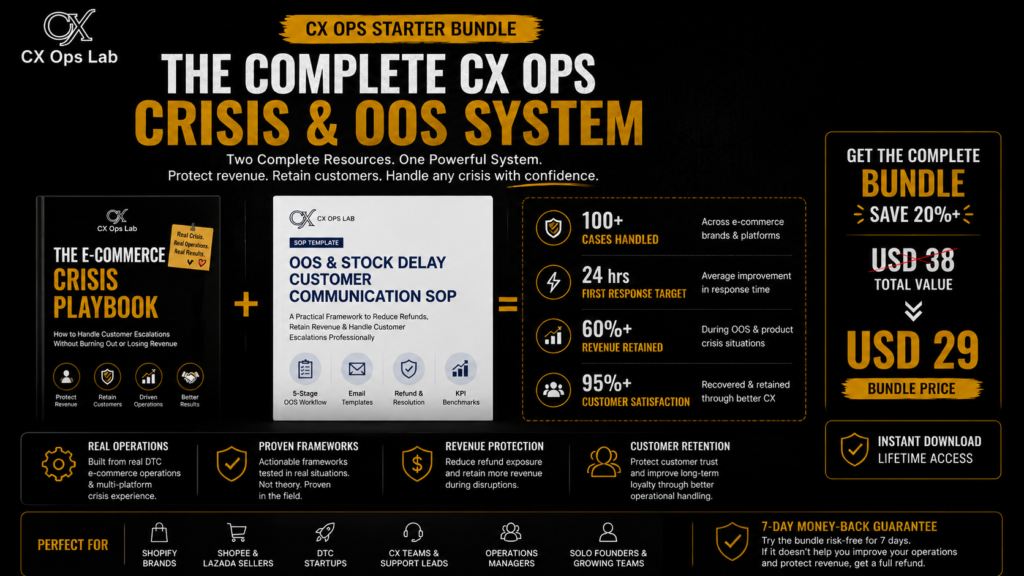
For the operational side of a product issue spreading into a Facebook ad comment crisis across platforms, the Crisis Playbook covers cross-platform detection and containment for Shopify, Shopee, and Lazada. Need both the operational and reputation side together? The Bundle covers the Crisis Playbook and the OOS SOP Template in one package.
Is Your Team Set Up to Contain This Before It Spreads?
Comment-level containment buys time, but it only works if the operational backbone behind it — escalation ownership, response SOPs, documentation — is already in place. The free Ecommerce Operations Health Check gives you a quick read on where those gaps might be sitting.
About CX Ops Lab
CX Ops Lab is built from real solo DTC ecommerce operations experience — managing thousands of orders and hundreds of thousands of dollars in GMV across Shopify, Shopee, and Lazada, including live multi-platform product crises, out-of-stock events, and reputation-risk incidents such as more than one Facebook ad comment crisis. Every framework, SOP, and checklist sold at cxopslab.io comes from what was actually used to run these operations solo — not theory. Explore the full product library at payhip.com/CXOpsLab.