
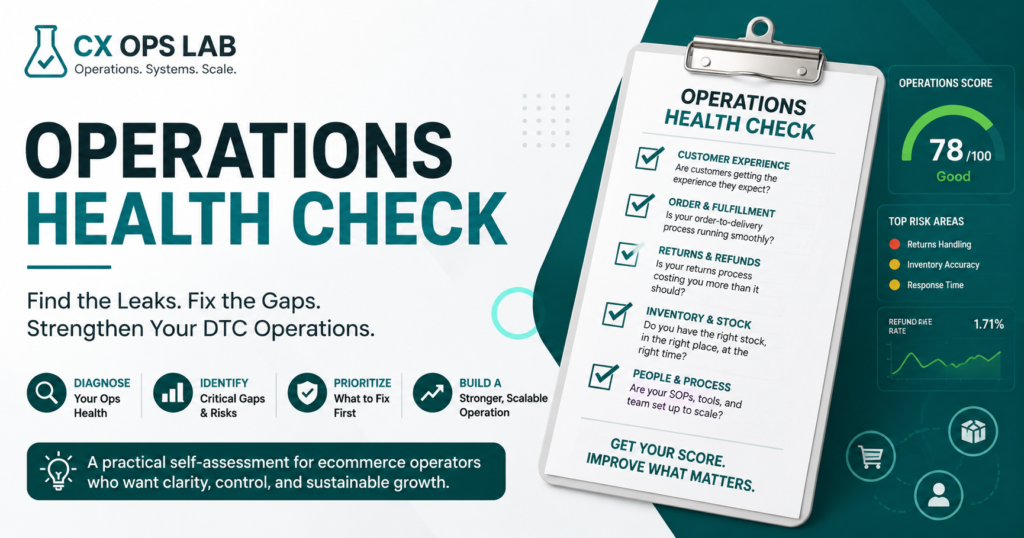
This ecommerce operations health check comes out of nine months running solo DTC operations across Shopify, Shopee, and Lazada — over 9,000 orders, roughly $610K in GMV, no team, just process. The 25 questions below cover customer support, order fulfilment, returns and refunds, and documentation, because those are usually the areas that quietly fall apart first when an operation scales past what one person can hold in their head.
Answer honestly rather than aspirationally. It takes about five minutes, and the score at the end reflects real operational gaps — not a vanity metric.
Frequent Ask Question:
Why 25 Questions Instead of 5
A five-question quiz gives you a vague impression. Twenty-five gives you a map. Each section isolates a specific failure point — whether your refund policy actually gets communicated at checkout, whether someone owns escalations when the founder is offline, whether return authorizations are tracked anywhere at all. Most operational breakdowns aren’t caused by one big mistake; they’re caused by five small gaps compounding at once, usually in the categories nobody reviews until something goes wrong.
What Your Score Actually Means
Returns and refunds alone account for a growing share of ecommerce cost — industry estimates put online return rates near 19% of sales in 2025, which is why that category carries real weight in this check. A high score here isn’t about having fancy tools; it’s about having documented, repeatable steps that don’t depend on one person remembering everything.
If your results point to gaps in SOP documentation specifically, the Ecommerce SOP Template walks through how to turn ad-hoc processes into something a new hire — or a future you — can actually follow.
Who This Ecommerce Operations Health Check Is For
This isn’t built for teams with a dedicated ops manager and existing dashboards — it’s built for the person doing customer support, chasing warehouse updates, and reconciling refunds between two or three platforms at the same time. If that’s your week, the categories above (customer support, fulfilment, returns, documentation, and continuous improvement) are the five places gaps tend to hide longest, because nobody’s watching them full-time.
A score in the 80s doesn’t mean nothing needs fixing — it usually means the fixes are small and specific rather than structural. A score under 50 usually means the same three or four problems are showing up across categories, which is actually good news: fix the root cause once instead of patching five symptoms separately.
Either way, the point isn’t the number. It’s seeing which category has the most red flags, and starting there instead of guessing.
How to Use Your Ecommerce Operations Health Check Results
Don’t just look at the total number and close the tab. Go back through your answers and circle every “No” — that’s your actual to-do list, ranked by category rather than by whatever feels urgent today. If most of your gaps cluster in one section, that’s where a single fix (a documented SOP, a shared inbox rule, a written escalation path) will move your ecommerce operations health check score more than trying to patch everything at once.
Retake it in 60-90 days if you make changes. Operations shift as order volume grows, and a health check that was accurate in Q1 won’t necessarily hold by Q3. Treat it less like a one-time grade and more like a checkpoint you come back to.
If you’re not sure where to start, the categories with the most red flags in your results are the ones costing you the most time right now — not necessarily the ones that feel most urgent.
That gap between “urgent” and “actually costly” is usually where operations quietly bleed hours every week.
Want a Deeper Diagnostic?
This free check gives you a directional read. The Professional Operations Health Check goes further — 25 questions across the same five categories, scored out of 100 instead of 25, with sharper thresholds and a specific next step based on where your operation actually sits. If your score here left you wanting more detail, that’s the next step.