

Every ecommerce SOP template library gets built the same way — after something breaks. A product defect triggers mass refund requests. An OOS event floods the inbox. A supplier delay generates platform disputes. And suddenly the team is improvising workflows under real operational pressure, at exactly the moment when structure matters most.
This post covers the five ecommerce SOP templates that should exist before any of that happens. These are not theoretical frameworks — they were built and pressure-tested managing 105+ crisis cases across Shopify, Shopee, and Lazada simultaneously, achieving a 95.1% escalation closure rate while keeping refund exposure below 7% of total affected order value.
If you run DTC ecommerce operations without these five SOPs documented, you are one bad batch away from an operational breakdown. Here is exactly what to build, and why each one matters.
Why DTC Brands Skip Ecommerce SOP Templates (And Why That Is a Costly Mistake)
The most common reason DTC brands skip documentation is speed. When you are a small team — or a solo operator managing thousands of orders — writing an ecommerce SOP template feels like the lowest-priority task on the list.
That calculation inverts completely during a crisis. When a product defect affects 105 orders across three platforms simultaneously, the absence of a documented ecommerce SOP template does not slow things down marginally — it multiplies error rate, creates inconsistent customer communication, and turns a manageable operational incident into a full-scale escalation breakdown.
The hard reality: a junior hire without SOPs is just a more expensive source of chaos. A solo operator without ecommerce SOP templates is one bad week away from total burnout.
According to Shopify, standard operating procedures are one of the most critical systems for scaling ecommerce operations reliably. The brands that survive product crises intact are not lucky — they have structured their CX operations with the same seriousness they apply to marketing.
SOP 1: Return & Refund Workflow — Your Most-Used Ecommerce SOP Template
What it covers
The Return & Refund SOP is the most foundational document in any CX operation. It defines exactly what happens from the moment a customer requests a return — through warehouse receipt, condition assessment, and refund processing.
Without this ecommerce SOP template, every return is handled differently. Refund timelines are inconsistent. Warehouse coordination is informal. Customer experience varies depending on who handles the case that day.
Core components
- Return eligibility criteria — conditions, timeframe, and exclusions per platform
- Platform-specific SLA rules — Shopify, Shopee, and Lazada each have different dispute windows
- Step-by-step customer communication sequence — from acknowledgment to resolution
- Warehouse coordination checklist — how returned units are logged, assessed, and classified
- Refund processing timeline — internal target and platform-specific processing windows
- Condition classification guide — restock, donate, quarantine, or dispose
Crisis relevance: During the product defect crisis, having a structured Return & Refund SOP in place before the crisis meant that even at peak volume — 24 Shopee cases and 22 Lazada cases simultaneously — every case followed the same processing sequence. Refund exposure remained at trackable, controlled levels.
| Return SOP Element | Target Standard |
| First customer acknowledgment | Within 24 hours of return request |
| Refund processing (post return received) | 1–3 business days |
| Platform dispute response | Within SLA (Shopee/Lazada auto-escalates) |
| Warehouse confirmation turnaround | Within 48 hours of receipt |
SOP 2: OOS & Stock Delay Customer Communication — Your Highest-Leverage Ecommerce SOP Template
What it covers
An OOS communication SOP defines the exact sequence of actions when stock becomes unavailable for orders already paid. It is a revenue protection workflow disguised as a customer communication template.
Most brands treat OOS situations as a logistics problem. The operational reality is that OOS is a customer communication problem. The logistics issue resolves when the stock arrives. The refund risk is created or contained in the first 24 hours — based entirely on how well you communicate.
Read the full OOS case study here: How We Retained 66.8% of OOS Revenue With One Proactive Email
The 6-step OOS response workflow
- Day 0: Confirm affected SKUs, total orders, and ETA from supplier or warehouse
- Day 0–1: Send mass proactive notification to ALL affected customers — before anyone escalates
- Day 1–14: Track every customer response into three outcomes: Wait Stock / Refund / Pending
- Day 3 & Day 7: Follow up with all Pending customers — do not let them go silent
- Stock arrival: Prioritise Wait Stock fulfilment first, send shipping confirmation immediately
- Post-event: Compile outcome report, update this ecommerce SOP template if process gaps were found
What proactive communication actually does to your refund rate
In a real OOS event covering 53 orders worth RM15,175 — a mass notification email sent on Day 1, offering two clear options (wait or full refund), produced the following outcome:
| Customer Decision | Orders | Revenue Impact |
| Agreed to wait for incoming stock | 35 orders | RM10,328.75 retained |
| Requested full refund | 6 orders | RM1,477.40 lost |
| Pending decision (follow-up active) | 13 orders | Under management |
| Final refund exposure rate | — | 9.7% of total OOS value |
Key insight: 68% of total OOS order value was retained through proactive communication alone — no discounts, no goodwill offers. Just a clear, timely email with two honest options.
The complete email sequence (Templates A–D), outcome tracker, and refund containment checklist are included in the OOS & Stock Delay Customer Communication SOP Template .
SOP 3: Customer Escalation Response — The Ecommerce SOP Template That Protects Your Brand Publicly
What it covers
An escalation response SOP defines exactly how your team handles complaints — tiered by severity, channel, and reputational risk. It removes guesswork from high-pressure situations and ensures that P1 escalations (public social media posts, marketplace disputes) receive consistent, fast handling every single time.
Priority tier framework
| Priority | Escalation Type | Target Response Time |
| P1 — Critical | Public Facebook post / negative marketplace review | Within 2 hours |
| P2 — High | Platform dispute / formal return request | Within 4 hours |
| P3 — Standard | Private message or email complaint | Within 8 hours |
| P4 — Monitor | General order status inquiry | Within 24 hours |
The containment principle every brand needs to understand
The goal of a public response is not resolution — it is migration. A Facebook comment or Shopee review should receive a brief, professional acknowledgment that moves the conversation into a private channel immediately.
Public resolution attempts almost always make the situation worse. They invite further public commentary, expose your internal processes, and create a visible complaint record that reduces conversion on that ad or product listing.
Standard public response formula: acknowledge, reassure, redirect. Once in a private channel, apply full resolution protocol: acknowledge the issue, explain the situation, offer options, confirm the customer’s decision, follow through without delay.
During the product defect crisis, negative spillover containment across Facebook ads and public comments was a daily operational task. The full escalation framework is covered in depth in How We Handled a Defect Batch Crisis Without Losing Customers or Revenue .
Outcome with a documented escalation SOP in place: 95.1% escalation closure rate across 102 tagged conversations, with zero major public escalation breakdown across three platforms.
SOP 4: Replacement Coordination & Tracking — The Ecommerce SOP Template That Protects Your Margin
What it covers
During a product defect crisis, replacements are the primary resolution tool — and the primary operational vulnerability. A replacement-first approach protects margin significantly better than a refund-first default. But it only works when the replacement process is structured, trackable, and warehouse-coordinated through a documented ecommerce SOP template.
Why replacement tracking breaks without a SOP
- Replacement stock gets mixed with standard outbound orders — leading to fulfilment errors
- ETA commitments are made without confirmed stock count — creating a second wave of complaints
- Defective incoming units get shipped because the batch was not verified before fulfilment
- No tracking visibility means customers escalate again when replacements do not arrive as promised
Core replacement SOP checklist
- Confirm verified incoming stock count before committing any ETA to any customer
- Log replacement shipments separately from standard outbound order flow
- Match every replacement tracking number back to the original order record
- Confirm receipt with customer within 48 hours of delivery scan
- Flag any replacement that generates a second complaint — escalate to quality review immediately
product defect crisis outcome: Replacement-first handling across Shopify, Shopee, and Lazada kept total refund exposure below RM10,000 across 95 reported cases. Of 23 closed Shopify cases, 15 were resolved through successful replacement — with only 4 proceeding to refund after replacement also failed.
SOP 5: Weekly Operational Reporting — The Ecommerce SOP Template That Prevents the Next Crisis
What it covers
Operational reporting is the ecommerce SOP template that most solo operators and small CX teams skip entirely — and it is the one that provides the earliest warning signal before a crisis escalates into something uncontrollable.
A weekly ops report does not need to be complex. It needs to capture three things consistently: what happened, what is still open, and what is at risk.
Core weekly reporting metrics
| Metric | Why It Matters for Crisis Prevention |
| Total cases by platform | Volume tracking — detects emerging platform-specific trends early |
| Refund amount and refund rate | Revenue protection visibility week over week |
| Open escalations | Pending risk before it becomes a platform dispute |
| Replacement fulfilment status | ETA commitment tracking — prevents broken promises |
| OOS or delay cases | Early warning before customer communication volume spikes |
| Macro usage frequency | Identifies repetitive issues needing SOP or policy update |
Why reporting is also a crisis-prevention tool, not just admin
The product defect crisis wave did not arrive as a single spike. It was a rolling pattern of complaints that began in March 2026 and peaked across three platforms by May. A weekly reporting cadence tracking case volume by platform provided early visibility into which channels were most affected — allowing proactive triage before each wave peaked.
Without weekly reporting, you are discovering crises at their peak. With it, you are seeing them on the slope.
How These 5 Ecommerce SOP Templates Work Together During a Crisis
Each ecommerce SOP template functions independently. Together, they form a crisis-containment operating system.
Here is how they interact during a compound scenario — a product defect event running simultaneously with an OOS situation, the exact scenario that produced the performance data referenced throughout this post:
| Crisis Stage | Primary SOP | Supporting SOP |
| Defect complaints begin arriving | Escalation Response SOP | Return & Refund SOP |
| Replacement stock depleted — OOS triggered | OOS Communication SOP | Replacement Tracking SOP |
| Returns from defect batch arrive at warehouse | Return & Refund SOP | Replacement Tracking SOP |
| Public comments on Facebook ads | Escalation Response SOP | — |
| Crisis stabilisation and review period | Weekly Reporting SOP | All four operational SOPs |
Compound crisis outcome: 95.1% escalation closure rate. Refund exposure below 7% of total affected order value. RM10,328.75 OOS revenue retained. All managed by a single-person operation — because the ecommerce SOP templates existed before the crisis, not during it.
Which Ecommerce SOP Template to Build First
If you are starting from zero, build in this sequence:
- Return & Refund SOP — highest daily operational usage, most immediate impact
- OOS Communication SOP — single highest-leverage revenue protection document
- Escalation Response SOP — handles everything that does not fit the first two
- Replacement Coordination SOP — essential before any defect or quality issue occurs
- Weekly Reporting SOP — build this last, but build it before volume scales
If you already have partial documentation, audit each SOP against the component checklists above. Most teams have coverage gaps — a refund policy that does not address warehouse coordination, or an escalation guide without defined priority tiers. Gaps in the ecommerce SOP template are gaps in crisis resilience.
Get a Ready-to-Use Ecommerce SOP Template
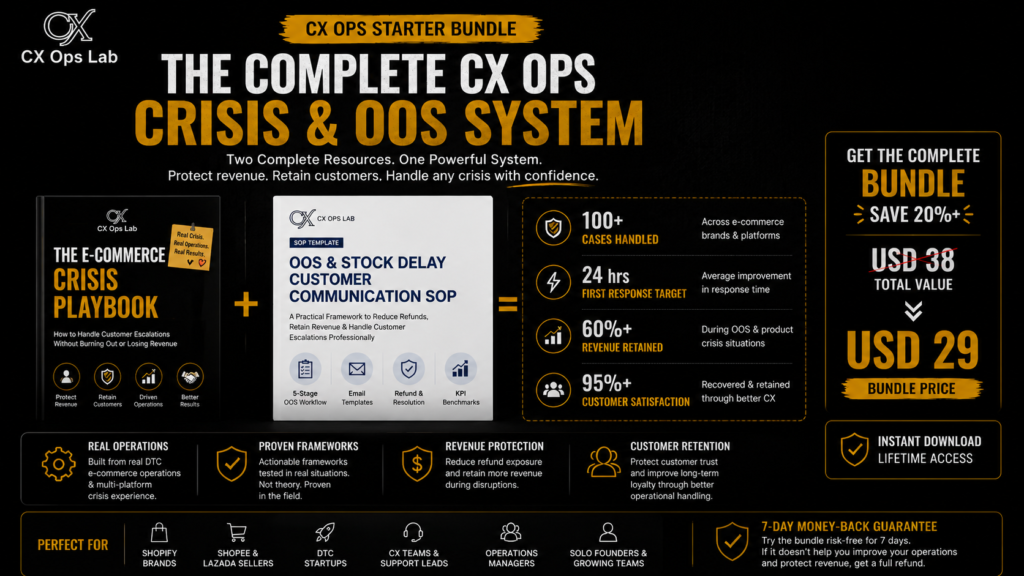
The OOS & Stock Delay Customer Communication SOP Template includes the complete 6-step response workflow, email Templates A–D, a customer outcome tracker, and a refund risk management framework — built from real DTC crisis management data. Available at $19.
The E-commerce Crisis Playbook covers the full five-SOP operating system — escalation containment, replacement coordination, warehouse handling, and team scaling frameworks. Available at $19.
Both resources are available at cxopslab.io/products.
Final Thoughts on Building Your Ecommerce SOP Template Library
Ecommerce crises are not rare. They are a predictable feature of running a DTC brand at scale — product quality issues, supplier delays, platform SLA pressure, and customer escalation patterns all follow recognisable cycles.
The brands that survive them with revenue and customer relationships intact are not lucky. They have their ecommerce SOP template library in place before they need it.
Five SOPs. Built before the fire. That is the entire system.
Ready to Audit Your Full SOP Coverage?
Five SOPs is a starting point, not a finish line. If you’ve already got the basics documented and want to see where the bigger gaps actually are — in escalation ownership, KPI reporting, or process control — the Professional Operations Health Check scores your operation across the same five areas out of 100, with sharper thresholds than a quick self-check.
Take the Professional Health Check →
About CX Ops Lab
CX Ops Lab publishes ecommerce SOP templates and operational playbooks built from real DTC operations — not theory. Resources are based on managing 7,936 orders, RM2.3M+ in gross sales, and a live multi-platform crisis across Shopify, Shopee, and Lazada.