
Category: Crisis Management | Reading time: ~9 min
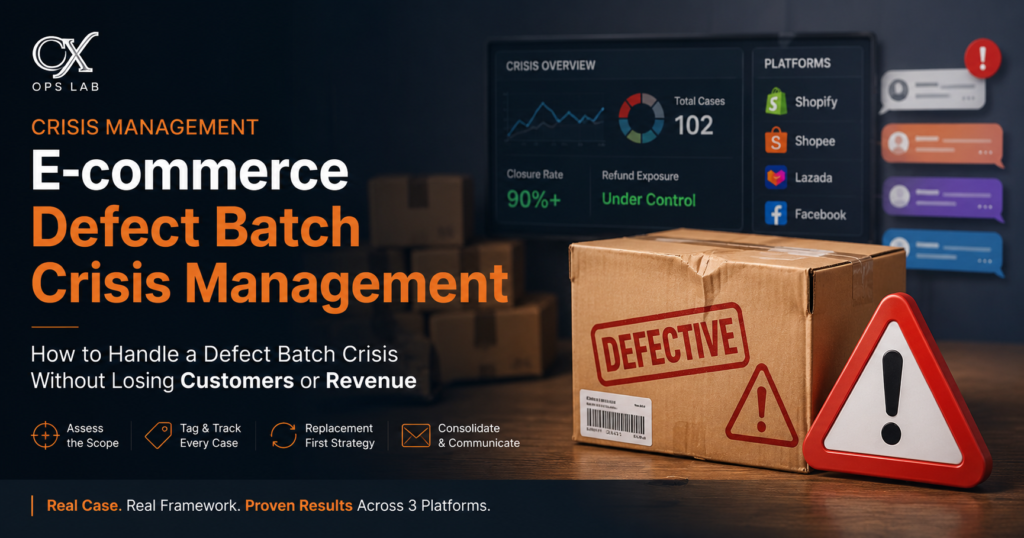
A defective product batch is one of the highest-risk events a DTC e-commerce brand can face. Unlike a single customer complaint, a defect batch triggers simultaneous escalations across every sales channel — Shopify, Shopee, Lazada, Facebook — often within the same 24-hour window.
The brands that survive it without major revenue loss are not the ones that got lucky. They’re the ones that had a structured ecommerce defect batch crisis management framework in place before the crisis hit — or built one fast enough when it did.
This article breaks down the exact decision logic, escalation structure, and operational workflow used to resolve over 90% of defect-related cases across three sales platforms, while keeping refund exposure well below what the volume of complaints would normally produce.
No product codes, no company names — just the framework you can adapt and deploy.
What Makes Ecommerce Defect Batch Crisis Management Different From Normal Returns
Standard return handling is linear: one customer, one ticket, one resolution. A defect batch crisis is exponential: the same defect triggers dozens or hundreds of parallel escalations, all requiring consistent handling while the team is still diagnosing the root cause.
The operational gap that most brands fall into looks like this:
| Without a Crisis Framework | With a Crisis Framework |
| Every agent handles the complaint differently | Consistent response logic across all tickets |
| Refund is the default resolution | Replacement-first workflow reduces margin leakage |
| Customers escalate publicly on social | Escalation path is controlled before it reaches social |
| No data on scope or velocity | Case tagging tracks scale in real time |
| Crisis drags for weeks | Closure rate stays high; backlog stays manageable |
The core difference is that ecommerce defect batch crisis management is not a support problem — it’s an operational containment problem. The goal is not just to resolve individual complaints. It’s to control the escalation trajectory across all channels simultaneously.
The Ecommerce Defect Batch Crisis Management Framework: 5 Layers
This framework was deployed across a live defect event affecting approximately 95 reported cases across three platforms. The structure has five operational layers:
Layer 1 — Immediate Scope Assessment
The first 24 hours of a defect batch crisis determine the trajectory. Before any customer communication goes out, you need answers to three questions:
- How many affected units are in circulation? (estimate from sales data, not warehouse count)
- Which platforms are generating complaints and at what velocity?
- Is the defect consistent, or are there multiple failure modes?
This assessment determines whether you’re handling a contained issue (one batch, one SKU, manageable volume) or a systemic one (multiple batches, cross-SKU, uncontrolled spread). The response scale depends entirely on this.
Layer 2 — Centralized Escalation Tagging
Once the scope is understood, every incoming complaint must be captured and tagged under a consistent system — not handled ad hoc. In this case, a dedicated tag was applied to every conversation in the helpdesk tool, making it possible to track:
- Total case volume across platforms in real time
- Outcome distribution: replacement accepted / refund requested / pending
- Platform-by-platform breakdown to identify where escalation was heaviest
Without centralized tagging, the crisis looks bigger than it is because cases are invisible until they explode. With tagging, the team could see that over 100 conversations were being tracked — and that the closure rate was staying above 90%.
For a deeper breakdown of how escalation tagging and closure tracking works end-to-end, see Customer Escalation Management: The Exact Workflow That Closed 95.1% of Crisis Cases Across 3 Platforms.
Layer 3 — Replacement-First Resolution Logic
The most consequential decision in ecommerce defect batch crisis management is the default resolution path. Refund-first handling is the easiest to execute but the most expensive in margin terms. Replacement-first handling requires more coordination but protects revenue significantly better.
The replacement-first decision tree looked like this:
| Customer Situation | Resolution Path |
| Confirmed defect — customer willing to wait | Replacement unit dispatched; waitstock timeline communicated |
| Confirmed defect — customer unwilling to wait | Full refund processed without friction |
| Replacement received but still defective | Escalate to full refund; no further replacement attempt |
| Complaint unverified / cosmetic issue only | Investigate before committing to replacement or refund |
| Platform dispute already opened | Prioritise resolution before platform intervenes |
The key principle: every customer gets a clear path. No vague ‘we’re looking into it’ holding responses. Each case either moves toward replacement, refund, or a defined next step within a set timeframe.
Layer 4 — Email-Thread Consolidation Workflow
On multi-platform brands, the same customer complaint can arrive via Shopify email, Shopee chat, Lazada messaging, and Facebook comments — sometimes simultaneously. Without a consolidation workflow, this creates duplicate handling and contradictory responses.
The consolidation approach used here:
- All escalations funnelled into a central helpdesk thread per customer
- Platform-specific ticket closed or redirected to main thread once identified
- Single point of record per customer — one thread, one outcome, one agent ownership
- Prevents the customer receiving different responses on different channels
This sounds simple. In practice, during a high-volume crisis, it’s the step most teams skip — and it’s the primary driver of duplicate refunds and contradictory commitments.
Layer 5 — Public Escalation Containment
Defect batch complaints don’t stay in private channels. Facebook ad comments, Shopee reviews, and Lazada ratings are the highest-risk spillover points — visible to prospective buyers and capable of accelerating the crisis far beyond the actual affected customer base.
The containment approach:
- Monitor ad comment sections daily during the crisis window
- Respond to public complaints with a de-escalation script that moves the conversation to private messaging
- Avoid detailed public acknowledgment of the defect — keep specifics in private resolution threads
- Do not delete negative comments — this escalates faster than any defect
The goal in public channels is not to win the argument. It’s to move the conversation out of public view before it compounds.
This same public-containment logic applies directly to social spillover — see Facebook Ad Comment Crisis: How We Contained a Negative Comment on an Active Ad in 4 Hours for the exact 4-hour detection-to-resolution workflow used on a live ad.
Ecommerce Defect Batch Crisis Management: What the Outcome Data Looked Like
Across approximately 95 reported cases spanning three platforms and a multi-month handling window, the operational outcomes were:
| Metric | Outcome |
| Total reported cases | ~95 across 3 platforms |
| Helpdesk conversations tagged and tracked | ~100+ |
| Cases successfully closed or resolved | ~90+ (90%+ closure rate) |
| Cases remaining open at end of active handling period | ~5 |
| Replacement-completed cases (of closed) | ~60% |
| Refund cases (of closed) | ~17% |
| Waitstock cases still pending stock arrival (of closed) | ~17% |
| Refund exposure vs total affected volume | Contained — well below 20% of case volume |
The replacement-first approach was the primary driver of the low refund rate.
When customers are offered a clear, credible replacement path with a defined timeline, the majority will take it — even after receiving a defective product.
Cross-Platform Defect Crisis Management: Why Each Channel Needs a Different Approach
One of the most underestimated challenges in ecommerce defect batch crisis management is that different platforms have different escalation mechanics, different customer expectations, and different risk profiles.
| Platform | Key Risk | Handling Priority |
| Shopify (direct) | Direct customer relationship — highest loyalty risk if mishandled | Personalised email handling; replacement-first default |
| Shopee | Platform dispute system — cases escalate to Shopee review quickly | Fast acknowledgment; avoid platform dispute trigger |
| Lazada | Return workflow controlled by platform; refunds can be forced | Proactive resolution before platform auto-processes |
| Facebook / Social | Public visibility — negative comments visible to all ad audiences | De-escalate publicly; resolve privately |
Managing a defect crisis across these four channels simultaneously requires a different communication tone and priority threshold for each — while maintaining consistent resolution logic at the backend.
Ecommerce Defect Batch Crisis Management: The First 48-Hour Action Checklist
If you’re in the middle of a defect crisis right now, this is the sequence that matters most:
- Hour 0–6: Confirm the defect is real and batch-wide. Pull affected order data. Do not communicate to customers yet.
- Hour 6–12: Tag all incoming complaints in your helpdesk. Assign a dedicated label. Count active cases.
- Hour 12–24: Draft your replacement-first response template. Define the resolution decision tree. Brief anyone handling tickets.
- Hour 24–36: Begin proactive outreach to affected customers who haven’t complained yet — get ahead of the escalation.
- Hour 36–48: Check public channels. Address any visible comments. Ensure platform dispute windows haven’t been triggered.
- Hour 48+: Review case closure rate. Identify any patterns in the complaints (specific batch range, shipping region, product variant). Feed this back into the replacement coordination workflow.
What Most Brands Get Wrong in Ecommerce Defect Batch Crisis Management
- Treating it as a customer service problem instead of an operational containment problem
- Defaulting to refunds because it’s faster — accelerating margin damage unnecessarily
- No centralized tracking, so the crisis feels bigger than it is and resources are misallocated
- Allowing public complaints to go unaddressed for more than 24 hours
- Sending inconsistent messages across platforms — customers compare notes, and inconsistency destroys trust faster than the defect itself
- No post-crisis review — the same failure mode reappears in the next batch incident
Ecommerce Defect Batch Crisis Management Is a System Problem, Not a People Problem
The brands that come out of a defect batch crisis with their customer base intact and their margin protected are not the ones with the most experienced support team. They’re the ones with a defined framework that activates before the volume becomes unmanageable.
A 90%+ case closure rate across 95 simultaneous escalations on three platforms was not the result of heroic individual effort. It was the result of consistent decision logic, centralized tracking, and a replacement-first resolution path applied systematically from the start.
The framework above is not complex. What it requires is the discipline to follow it when the volume is high and the pressure to just refund everyone feels like the easier path.
The CX Ops Lab E-commerce Crisis Playbook documents this full framework — including the replacement-first decision tree, escalation tagging structure, and public containment SOP — in a deployable format.
→ Available at cxopslab.io
Would Your Own Crisis Response Hold Up?
A decision tree helps in the moment. But the bigger question is whether your operation has the underlying structure — clear escalation paths, documented refund logic, a communication plan — to handle the next one faster. The free Ecommerce Operations Health Check scores exactly that across five categories in about five minutes.
About CX Ops Lab
CX Ops Lab publishes operational frameworks, SOP templates, and case-study content built from real DTC ecommerce operations — not theory. Every framework was pressure-tested during live operational conditions across Shopify, Shopee, and Lazada at $610K+ USD GMV scale.
Website: cxopslab.io | Products: payhip.com/CXOpsLab