
Category: OOS & Stock Delay Management | Reading time: ~8 min
Out of stock customer communication is the single most effective tool for protecting revenue during a stock delay — yet most brands get it wrong.
Most e-commerce brands treat an out-of-stock event as a logistics problem. They wait for inventory to arrive, then notify customers — usually after frustration has already set in.
This article breaks down a different approach: out-of-stock customer communication as a revenue protection strategy, executed proactively from Day 1 of the OOS event.
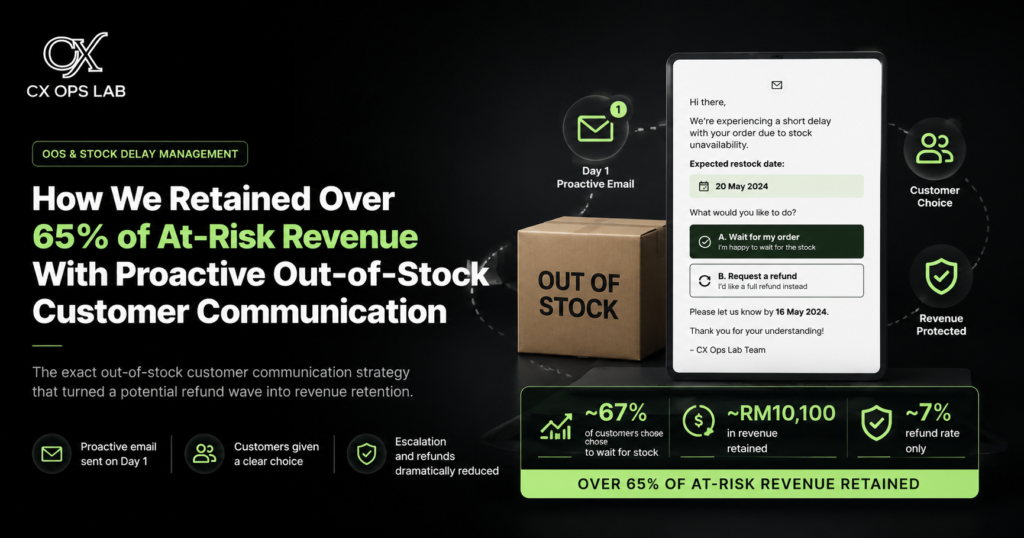
The result? More than 65% of at-risk order value was retained. Customers chose to wait instead of requesting refunds — not because they had no choice, but because the communication gave them confidence.
Here’s exactly how it was done, and how you can replicate it.
The Out-of-Stock Customer Communication Challenge
An unexpected stock disruption affected dozens of pending orders simultaneously. The timing was poor — inventory delays overlapped with an existing operational escalation period, meaning the team was already managing a high-volume customer support backlog.
The risk breakdown looked like this:
| Risk Factor | Detail |
| Orders affected | ~50 orders pending fulfilment |
| Total order value at risk | Approximately $3,400 USD (RM15,000) |
| Escalation risk | High — overlapping with existing ops crisis |
| Refund exposure without action | Potentially 40–60% of total value |
Without proactive intervention, the default outcome would have been a flood of ‘where is my order?’ tickets, escalating into refund requests, negative reviews, and platform disputes.
The decision was made to get ahead of it — before a single customer had the chance to escalate.
The Out-of-Stock Customer Communication Strategy: Day 1 Execution
On the first day the stock delay was confirmed, a mass customer notification was sent to all affected order holders. This is the most critical lever in OOS communication — timing.
The email was not a generic delay apology. It was structured around three specific objectives:
- Give customers a clear, honest ETA for incoming stock
- Offer a genuine choice: wait for stock or receive a full refund
- Set expectations in a way that reduced the need for follow-up contact
The goal was not just to inform customers — it was to transfer decision-making power back to them.
When customers feel in control, they escalate less. When they escalate less, refund pressure drops.
What the OOS Notification Email Covered
- Subject line: Clear, non-alarming, specific to their order status
- Reason for delay: Brief, honest — no over-explanation
- Expected restock date: Specific ETA, not ‘soon’ or ‘as soon as possible’
- Option A — Wait: Confirm they’re happy to hold the order until stock arrives
- Option B — Refund: Full refund with no friction, offered upfront
- Response deadline: A soft window for customers to reply, reducing open-ended uncertainty
The response workflow was tracked in a live spreadsheet, with each customer outcome tagged under three categories: Wait Stock, Full Refund, or Pending Decision. This made follow-up systematic, not manual.
Out-of-Stock Communication Outcome: What the Data Shows
Across all affected orders, the customer response breakdown looked like this:
| Customer Outcome | Approx. Orders | Est. Value | % of Total |
| Agreed to wait for stock | ~34 | ~$2,300 USD (RM10,100) | ~67% |
| Requested full refund | ~4 | ~$230 USD (RM1,000) | ~7% |
| Pending / no response yet | ~15 | ~$910 USD (RM4,000) | ~26% |
Key outcomes from this OOS communication approach:
- Over 65% of total at-risk order value was retained without a refund
- Refund exposure remained at approximately 7% of total OOS order value
- No large-scale escalation occurred — zero platform disputes triggered during the stock delay period
- Follow-up workload was significantly reduced because expectations had already been set
The refund rate during this OOS event was lower than the average refund rate across normal operations.
Proactive out-of-stock customer communication doesn’t just reduce escalation — it can reduce refunds below your baseline.
Why Proactive Out-of-Stock Customer Communication Works
Most OOS escalations don’t start because a customer is upset about the delay. They start because the customer had no information and felt ignored.
Proactive OOS communication works because it addresses the root cause of escalation — uncertainty — before the customer has the chance to act on it.
| Without Proactive OOS Comms | With Proactive OOS Comms |
| Customer discovers delay themselves | Customer informed before they notice |
| First contact is a complaint | First contact is a structured notification |
| Refund request is the default reaction | Refund is offered as a choice, not demanded |
| Repeat follow-up tickets pile up | Single communication sets expectations |
| Platform disputes risk rises | Escalation pathway is controlled |
The structural difference is simple: reactive OOS handling puts the customer in control of the escalation path. Proactive OOS handling puts the operator in control of the outcome.
How to Replicate This Out-of-Stock Customer Communication System
This is not a complex system. It’s a structured response executed at the right moment. Here’s the repeatable framework:
Step 1 — Identify affected orders immediately
The moment a stock delay is confirmed, pull the full list of unfulfilled orders for that SKU. Don’t wait for customers to contact you first.
Step 2 — Send the notification within 24 hours
Timing is the highest-leverage variable. Sending on Day 1 of a stock delay is fundamentally different from sending on Day 7. The sooner customers are informed, the less emotional momentum builds behind a refund request.
Step 3 — Offer a genuine choice, not a non-answer
Give customers a real ETA and two clear options. Vague communication (‘we’ll update you soon’) produces anxiety. A specific date and a binary choice produces a decision.
Step 4 — Track every customer response
Use a live tracking structure — even a basic spreadsheet — to tag each customer under Wait Stock, Refund, or Pending. This prevents customers from falling through the cracks and makes follow-up systematic.
Step 5 — Follow up on pending decisions
Customers who don’t respond within 5–7 days need a single follow-up. Keep it short. Restate the options. Set a response deadline to close the loop.
Common Out-of-Stock Communication Mistakes That Drive Refunds
- Waiting until the customer complains before communicating the delay
- Sending a delay notice without a specific ETA — ‘coming soon’ accelerates frustration
- Not offering a refund option upfront — customers who feel trapped escalate harder
- Failing to track responses — ‘pending’ customers become surprise refund requests weeks later
- Using a generic delay template with no personalization to the customer’s order
Out-of-Stock Customer Communication Is an Operations Problem, Not Just a Support Problem
The brands that retain revenue during OOS events are not the ones with the best apology emails. They’re the ones with a systematic communication and tracking workflow that activates the moment a stock issue is identified.
The outcome data from this case is clear: proactive communication, a clear ETA, and a structured choice produced a refund rate of approximately 7% on affected orders — during a period when the default outcome could have been 40% or higher.
That gap is the value of treating OOS communication as an operational system, not an afterthought.
Want the full OOS communication system? The CX Ops Lab OOS & Stock Delay SOP Template includes the exact email sequence structure, customer outcome tracking spreadsheet, and refund containment checklist used in this case.
→ Available at cxopslab.io
How Does Your OOS Process Actually Hold Up?
A good OOS email sequence solves one problem. But if stock delays keep exposing the same gaps — no clear ownership, no tracking, no fallback plan — that’s usually a sign the issue sits one level up, in the operation itself. The free Ecommerce Operations Health Check covers OOS handling alongside four other categories, so you can see whether it’s an isolated gap or a pattern.
About CX Ops Lab
CX Ops Lab publishes operational frameworks, SOP templates, and case-study content built from real DTC ecommerce operations — not theory. Every framework was pressure-tested during live operational conditions across Shopify, Shopee, and Lazada at $500K+ USD GMV scale.
Website: cxopslab.io | Products: payhip.com/CXOpsLab