
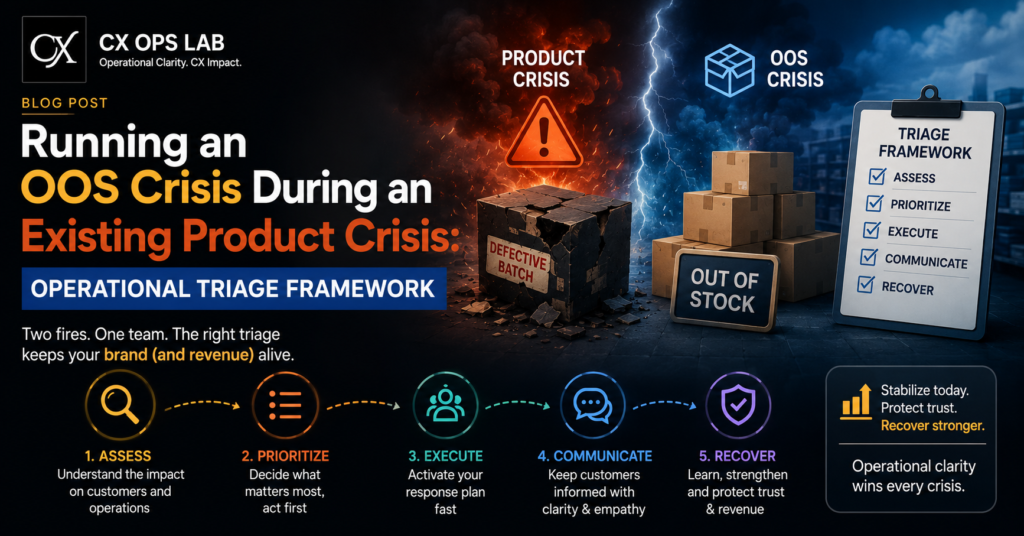
Ecommerce dual crisis management is the discipline of running two active incidents at once without either one taking down your customer experience — and it’s a scenario most operational playbooks never prepare you for. Most crisis frameworks assume you are dealing with one problem at a time: a defect, a delay, a supplier failure. But operations rarely wait politely in line. In one solo-operated DTC business, a product defect crisis that had already generated 95+ complaints across three platforms was still active when a separate out-of-stock event hit 53 orders simultaneously. That overlap is what this article is built around: a real operational triage framework for ecommerce dual crisis management when a second incident lands on top of a first one that hasn’t been resolved yet.
What Is an Ecommerce Dual Crisis, and Why Is It Different From a Single Incident?
An ecommerce dual crisis is any situation where two independent operational failures — a product defect, a stockout, a shipping disruption, a payment gateway outage — are active in the same customer base at the same time. The danger isn’t that you have twice the workload. It’s that the two incidents interact with each other in ways that make each one worse.
In the case this framework is based on, the connection was direct: replacement stock for a defective product ran out faster than expected because it was simultaneously being used to fulfil normal orders and to fulfil replacement requests from the defect queue. The stockout wasn’t a separate event — it was partly caused by the first crisis. That is the pattern to watch for. Ecommerce dual crisis management starts with recognizing that your two “separate” problems are very often the same problem wearing two different masks.
The Scale of the Problem: What Two Overlapping Incidents Actually Looked Like
Here is the real operational data from the period when both incidents were active at once, run solo across Shopify, Shopee, and Lazada.
| Metric | Figure |
|---|---|
| Total defect-related cases (already active) | 95+ across 3 platforms |
| Tagged customer conversations managed | 102 |
| Overlapping OOS orders affected | 53 orders (~$3,449 USD / RM15,175) |
| Platforms affected simultaneously | Shopify, Shopee, Lazada, Facebook |
| Team size managing both incidents | 1 person (solo operations) |
| Final escalation closure rate | 95.1% |
| OOS revenue retention rate | 66.8% |
Those numbers are the entire point of ecommerce dual crisis management: a 95.1% closure rate and a 66.8% retention rate weren’t achieved because the defect crisis and the OOS event were treated as one blended mess. They were achieved because each incident was classified, separated, and triaged with its own workflow — while still accounting for the fact that the same customers, the same warehouse, and the same support inbox were shared between them.
Why Ecommerce Dual Crisis Management Needs Its Own Framework
Running a product defect response and an out-of-stock containment at the same time is operationally dangerous for four specific reasons:
- Customers already in the defect queue are at the highest churn risk in your entire base — any additional friction, including an unrelated shipping delay, accelerates refund requests.
- Replacement stock depletes faster than normal, creating an OOS exposure that would not have existed without the first crisis.
- Platform SLA clocks on Shopify, Shopee, and Lazada keep ticking regardless of your internal bandwidth — a missed response window on one platform doesn’t pause because you’re mid-crisis on another.
- A complaint that starts on one platform’s review section can spill onto Facebook ad comments within hours, compressing your response window across every channel at once.
This is the operational reality that generic customer service training doesn’t cover. Single-incident thinking treats every ticket as its own event. Ecommerce dual crisis management treats the entire customer base as one interconnected system where two active incidents are competing for the same limited attention, inventory, and trust.
| The Compounding Risk : A defect crisis and an OOS event happening in isolation are each manageable with a standard SOP. The same two events happening together compress your decision window, split your attention across contradictory priorities, and put every affected customer one bad interaction away from a public escalation. Ecommerce dual crisis management exists specifically for this compounding scenario — not for either incident on its own. |
The Operational Triage Framework for Ecommerce Dual Crisis Management
This is the four-step sequence used to run both incidents at once without either one collapsing into manual chaos.
Step 1 — Classify and Separate the Two Incidents
The first move in ecommerce dual crisis management is refusing to let the two incidents blend into a single undifferentiated firehose of tickets. Every incoming conversation gets tagged at first contact: defect-related, OOS-related, or — critically — both. A customer who is waiting on a defect replacement and now also affected by the stock delay needs a distinct tag, because that segment carries the highest churn risk in the entire crisis.
- Tag every conversation by root cause at first contact, not after triage.
- Create a third tag specifically for customers affected by both incidents.
- Route each tag to a dedicated workflow, even if one person is handling all of them.
Step 2 — Apply a Priority Matrix, Not a First-In-First-Out Queue
Under normal support volume, first-in-first-out is fair. Under a dual crisis, it’s dangerous, because it treats a cosmetic question and a customer who has been in the defect queue for three weeks and just got hit with a stock delay as equal priority. The priority matrix used here ranked cases on two axes: platform visibility (does this complaint have public review or comment exposure) and overlap status (is this customer affected by one incident or both).
| Priority | Criteria | Response Target |
|---|---|---|
| P1 — Critical | Overlap customers (both incidents) with public visibility | Within 2 hours |
| P2 — High | Overlap customers, private channel only | Within 6 hours |
| P3 — Standard | Single-incident customers, any channel | Within 24 hours |
Step 3 — Protect the Warehouse Layer Before It Becomes a Third Crisis
Ecommerce dual crisis management fails at the warehouse level more often than it fails in the inbox. If defective return units and OOS-affected replacement stock share the same physical space without segregation, you risk shipping a defective unit as a replacement for the stock delay — turning two incidents into three. A daily written warehouse sync (inbound count, outbound processed, segregated defective units) is the minimum viable coordination layer during any dual-incident period.
Step 4 — Set Dual SLAs and Communicate Proactively on Both Fronts
The single highest-leverage action in this entire framework was proactive, same-day communication on the newer incident. On Day 1 of the confirmed stock delay — before a single complaint had arrived about it — all 53 affected customers received a notification email offering two clear choices: wait for incoming stock, or receive a full refund. That one message, sent while the defect crisis was still fully active, is what produced the 66.8% revenue retention figure and zero public escalations from that segment during the waiting period. The full sequence and email structure behind that result is broken down in
Case Study: Ecommerce Dual Crisis Management Across Three Platforms
By the time the stock delay was confirmed, the defect crisis had already produced 95+ complaints across Shopify, Shopee, and Lazada, tagged into 102 active conversations. Rather than treating the new OOS event as an interruption to that response, it was folded into the same operational system with its own tags, its own priority matrix, and its own tracking sheet — while sharing the same escalation-closure discipline that had already been built for the defect response.
The overlap segment — customers affected by both incidents — received white-glove handling: proactive updates on both fronts, a single point of contact, and priority refund processing where requested. Refunds for OOS-affected customers who chose that option were processed within one to two business days. Non-responders were followed up at Day 3 and Day 7. The result: 95.1% closure across both incidents combined, and only 4 refund requests out of 53 OOS-affected orders. The complete tagging and escalation logic used to hit that closure rate is detailed in
The complete tagging and escalation logic used to hit that closure rate is detailed in The Exact Escalation Workflow We Used to Close 95.1% of Crisis Cases Across 3 Platforms, and the customer-decision tracking method that kept both incidents visible in one place is covered in How to Track Customer Decisions During an OOS Event (With a Real Outcome Table).
Common Mistakes That Turn a Manageable Dual Crisis Into a Brand Crisis
These are the mistakes that turn a workable ecommerce dual crisis management effort into a full brand-level incident.
- Treating the second incident as “less urgent” because the first one already has your attention — this is exactly backwards, since the second incident is newer and less contained.
- Using one generic tag for everything instead of separating root causes — this makes it impossible to see which customers are carrying compounded risk.
- Delaying communication on the newer incident until the older one is resolved — proactive Day 1 communication is what prevented the OOS event from becoming a second public escalation wave.
- Failing to sync with the warehouse, resulting in replacement stock and defective returns being handled by the same untracked process.
- Letting one person absorb both incidents without a written framework, which works until volume spikes and there is no repeatable system to fall back on.
Building Your Own Ecommerce Dual Crisis Management System
You don’t need enterprise tooling to run this framework. What you need is a tagging convention that separates root causes, a priority matrix that accounts for overlap, a warehouse sync cadence, and a proactive communication habit that fires on Day 1 of any new incident — even while an older one is still open. Ecommerce dual crisis management is less about having more resources and more about refusing to let two problems blur into one unmanageable queue.
For a deeper look at the specific defect-response structure this framework was layered on top of, see How to Handle a Defect Batch Crisis Without Losing Customers or Revenue, and for the exact email sequence that converted OOS customers into wait-stock agreements, see The OOS Communication Sequence That Turned 34 Customers Into Wait-Stock Agreements.
Retention behavior under stress is well documented outside of this case too — broader ecommerce churn research from Gorgias shows how quickly non-subscription customers disengage when support friction increases, which is exactly the dynamic ecommerce dual crisis management is designed to prevent.
Put This Framework to Work
If you’re managing a defect response, a stock delay, or — worst case — both at once, you don’t need to build your ecommerce dual crisis management system from scratch under pressure.
Start with the Ecommerce Crisis Playbook ($19) for the full defect-response framework, or the OOS SOP Template ($19) for the stock-delay workflow used in this case. Running both at once? The Bundle ($29) covers the complete dual-incident system, and the DTC Crisis Communication Framework ($79) builds out exactly what to say to customers on both fronts.
Could Your Operation Handle Two Crises at Once?
Running two overlapping crises exposes whatever isn’t documented — fast. If you’ve never stress-tested your own setup this way, the free Ecommerce Operations Health Check is a lower-stakes way to find the same gaps before they collide.
About CX Ops Lab
CX Ops Lab turns real, solo-operated DTC ecommerce experience into practical operational frameworks. The systems shared here were built managing a nine-month, $610,000 USD GMV operation across Shopify, Shopee, and Lazada — including a real multi-platform product defect crisis and a simultaneous out-of-stock event, run without a dedicated ops team. Every framework, checklist, and template is built from what actually worked under real operational pressure, not theory.
Website: cxopslab.io | Products: payhip.com/CXOpsLab