
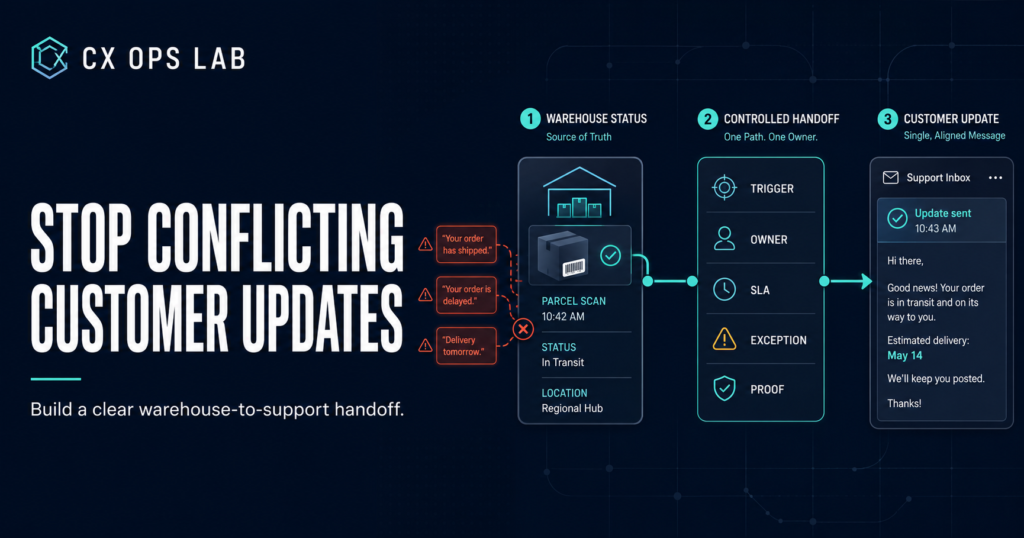
A customer emails asking where an order is. Support checks the tracking number and sees “delivered.” The customer replies that nothing arrived. Support checks again, finds no new scan, and asks the customer to wait another day. The warehouse team, working in a different tool three tabs away, already knows the parcel came back marked return-to-sender because the address had a typo. Nobody told support. The next reply the customer gets promises a replacement is on the way — twenty-four hours after being told to keep waiting for a package that was never coming. Now there are two different stories sitting in the same inbox thread, and the customer has screenshots of both.
That single contradiction costs more than one bad review. It is what a broken warehouse customer support workflow looks like from the outside: two teams operating on two different versions of the truth, with the customer stuck holding the mismatch.
Why the Symptom Isn’t the Real Problem
Most teams treat this as a communication issue and respond by asking people to check in more often. That fix rarely holds, because the problem isn’t attitude — it’s structure. Three gaps repeat across ecommerce operations that run into this pattern.
There is no defined trigger for when a warehouse event actually needs to reach support. Every exception looks urgent from inside the warehouse and invisible from inside the inbox, so decisions about what counts as worth flagging happen ad hoc, differently, every time, depending on who is on shift.
There are no shared fields. The warehouse logs a return-to-sender in an internal sheet using its own shorthand. Support has never seen that sheet and wouldn’t recognize the codes if they had, so even when information does move, it arrives in a format nobody on the receiving end can act on.
There is no named owner for the handoff itself. Fulfilment assumes support is watching the tracking feed. Support assumes fulfilment will flag anything that changes. Both assumptions are reasonable, and both are wrong — which is exactly why this gap survives so many “let’s communicate better” conversations without ever closing.
None of this shows up in a CSAT score right away. It surfaces two or three tickets later, once the same order has been described three different ways by three different people, and the customer stops trusting any version they’re given.
CONTEXTUAL CTA
See Exactly Where Your Handoff Breaks
The Professional Operations Health Check scores 25 areas of day-to-day operations, including cross-functional handoffs like this one, and shows where warehouse and support are working from different information. If your results point to real pressure and a defined priority, you can request a complimentary 30-minute Operations Review. Requests are limited and each one is assessed for operational fit before it’s confirmed — it isn’t an automatic booking.
Take the Professional Operations Health Check: https://cxopslab.io/professional-operations-health-check/
Prefer to fix the handoff yourself first? The CX Ops Recovery Bundle gives you the structure and templates to build it without waiting on a review: https://payhip.com/b/7PU0G
Building a Warehouse Customer Support Workflow That Doesn’t Rely on Memory
A handoff that actually works doesn’t depend on someone remembering to mention something. It runs on five fixed parts: a trigger, required fields, an owner, an SLA, and an exception route. Miss any one of these and the handoff quietly reverts to word-of-mouth, no matter how well-intentioned the team.
1. The Trigger
Define, in writing, the exact events that require a warehouse-to-support update — not “anything unusual,” but a specific list: order held for stock, address failure, damage found on outbound inspection, a carrier exception past a set number of days, return-to-sender, short-pick, or a wrong-item pick caught before dispatch. If an event isn’t on the list, it doesn’t need a handoff. If it is on the list, sending the update isn’t optional and isn’t left to judgment calls.
2. Required Fields
The update itself needs a fixed shape so support never has to interpret warehouse shorthand. At minimum: order ID, event type drawn from the fixed trigger list, the date and time the issue was discovered, the current physical status of the item, and the specific customer-facing consequence — delayed by how long, damaged and being replaced, or lost and being reshipped. A note that reads “issue with order 4482” is not a handoff. A note that states the event type, the timestamp and the customer-facing consequence is.
3. Owner
One person owns getting the update from warehouse to support — not “whoever notices first.” In a small operation this can be a single fulfilment lead; in a larger one it’s whoever runs the exception queue for that shift. The title matters less than the accountability: when something goes wrong, there’s exactly one name attached to whether the update reached support, not zero names and not three people each assuming someone else handled it.
4. SLA
Set a maximum time between an event being discovered in the warehouse and the update reaching support — commonly same business day for standard exceptions, and within a tighter window for anything already customer-facing, like a damage claim a customer has already raised. Without a time limit, “I’ll pass it along” quietly becomes “I passed it along two days after the customer already complained,” which functions the same as never sending it at all.
5. Exception Route
Some events won’t fit the standard list — a carrier loses a pallet, a supplier substitutes a component mid-run, a warehouse relocation disrupts picking for a week. Build one clearly marked route for these: a direct escalation to whoever owns customer communication decisions, bypassing the standard queue entirely. Without this route, unusual events either get forced into a process where they don’t fit and get delayed, or skipped altogether because nobody is sure whose job it is to raise them.
Proof of Completion
The handoff isn’t finished when a message is sent — it’s finished when there’s a record that support received it, understood it, and used it to correct any outstanding customer communication. A shared log with a timestamp, order ID and a short support acknowledgment is enough. This one addition is what turns “I told them” into something a manager can actually verify during a post-mortem, instead of two people disagreeing about who said what and when.
Applying It to a Real Exception
Take a delayed order. A carrier scan shows the package stuck at a regional hub for four days past the estimated delivery window. Under a defined trigger, that event gets flagged the moment it crosses the threshold — not when the customer eventually emails to ask. The fulfilment lead logs the order ID, the event type as a carrier delay at a regional hub, the date discovered, and the revised delivery estimate. That update reaches support within the SLA window, before the customer has a reason to write in at all. Support now has one accurate story to give if the customer does reach out, instead of guessing from a tracking page that hasn’t updated in days.
A damaged item works the same way. Outbound inspection catches a cracked case before the parcel ships. Under the fixed field structure, the event is logged as damage found on pre-dispatch inspection, with the replacement decision already noted alongside it. Support never has to discover the damage from an angry customer photo three days later, because the update already exists in the log and already has an owner attached to it.
Neither example depends on the warehouse team being more careful or the support team being more attentive on a given day. Both depend on the handoff having a defined shape that doesn’t rely on anyone’s memory.
Why This Matters More As Order Volume Grows
Coordinating one platform’s fulfilment updates with one support inbox is manageable by memory for a while. It stops being manageable the moment volume grows or a second sales channel gets added. Running solo operations across Shopify, Shopee and Lazada over 9,025 orders and roughly $610,000 USD in gross sales made this the difference between a 1.71% refund rate and something considerably worse — not because refunds were avoided outright, but because a customer who reached a support ticket almost always got one consistent version of what happened to their order, not three.
The commercial cost of getting this wrong is documented well beyond any single operation. A 2026 customer-service benchmark report built on Salesforce research found that a strong majority of consumers now expect their interactions to stay consistent across departments, not just fast. A conflicting update between warehouse and support is precisely the failure that expectation is measuring against.
Delivery-date communication carries the same weight from the customer’s side. Separate UX research from the Baymard Institute on shipping and delivery communication found that once a delivery date is shown to a customer, that customer treats it as a firm commitment rather than an estimate. That’s exactly why a support reply that contradicts a warehouse status — telling a customer to keep waiting for a package the warehouse already knows isn’t coming — reads to the customer as broken trust, not a minor scheduling gap.
If this kind of cross-team breakdown sounds familiar beyond warehouse-to-support handoffs, it’s worth checking how untracked return inventory creates the same kind of silent risk on the other side of the order lifecycle — see how untracked returns quietly become a warehouse and brand risk. The same structural fix — defined triggers, shared fields, a named owner — applies to tracking customer decisions during stock-out events; see how to track customer decisions during an OOS event.
Quick Check: Is Your Handoff Actually a Workflow?
Run through this before assuming the gap is fixed. If any answer is no, that’s the part of the handoff still running on memory.
- Is there a written list of exactly which warehouse events require a support update, rather than a general instruction to “flag anything unusual”?
- Does every update use the same fields — order ID, event type, date discovered, current status, customer-facing consequence — regardless of who writes it?
- Is there one named person or role accountable for getting each update from warehouse to support, with no ambiguity about whose job it is?
- Is there a maximum time limit between an event being discovered and the update reaching support, and does anyone check whether it’s being met?
- Is there a separate, clearly marked route for the exceptions that don’t fit the standard list, so they don’t get delayed inside a process built for routine cases?
- Is there a record — even a simple shared log — proving support received and acted on each update, rather than relying on someone’s memory of a Slack message?
A handoff that passes all six is a workflow. A handoff that passes two or three is still a set of good intentions, and it will fail again the next time volume spikes or someone is out sick.
Where to Take This Next
A one-off fix to a single handoff won’t hold once order volume changes or a new channel gets added — the underlying workflow gap tends to resurface somewhere else in the operation. If warehouse-to-support breakdowns are one of several places where your operation is still running on memory instead of a defined process, that pattern is worth a structured look rather than another ad hoc patch.
FINAL CTA
Some teams have the internal bandwidth to define triggers, fields, owners and SLAs on their own once they know what the workflow needs to contain. The CX Ops Recovery Bundle gives a structured, self-serve starting point for exactly this kind of cross-functional gap: https://payhip.com/b/7PU0G
Other teams are already stretched across too many priorities to build it alone and want an outside perspective on where the handoff is actually breaking before committing time to fixing it. The Professional Operations Health Check is the starting point for that conversation, and the complimentary 30-minute Operations Review remains optional, limited, and assessed for operational fit: https://cxopslab.io/professional-operations-health-check/
About CX Ops Lab
CX Ops Lab publishes operational frameworks, SOP templates, and case-study content built from real DTC ecommerce operations — not theory. Every framework was pressure-tested during live operational conditions across Shopify, Shopee, and Lazada at $610,000+ USD GMV scale.
Website: cxopslab.io | Products: payhip.com/CXOpsLab