
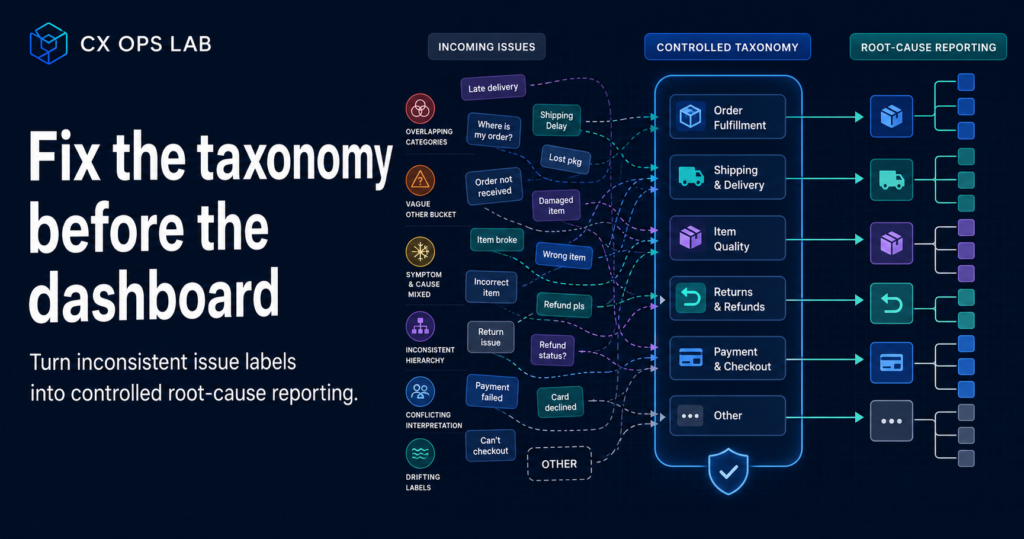
A support team can tag every conversation that comes in and still have no idea what is actually going wrong. This is the quiet failure mode of an ecommerce issue taxonomy: the categories exist, the dashboard fills up, and the reports still can’t tell an operator which process is broken. Leadership looks at a pie chart of “Shipping,” “Product,” “Other,” and “Miscellaneous,” nods, and moves on — while the same three root causes keep generating the same complaints under different labels.
The problem is rarely that nobody is tagging. The problem is that the taxonomy itself was never built to survive contact with real operations. Categories overlap, agents interpret them differently, and nobody owns the definitions once the initial setup is done. Six months later, the classification system is producing numbers nobody trusts enough to act on.
This article breaks down the six classification errors that quietly destroy root-cause reporting, and lays out a correction protocol for fixing a taxonomy that already exists — without starting from a blank sheet.
Why a Taxonomy Fails Quietly, Not Loudly
A broken taxonomy rarely announces itself. Tickets still get closed. CSAT scores still get collected. Reports still ship on schedule. What disappears is the ability to answer one specific question: which operating process is generating this volume, and is it getting better or worse?
That failure is invisible until someone tries to use the data for a decision — approving a supplier change, justifying a headcount request, or explaining to a founder why refund rate hasn’t moved despite three “fixes” in the last quarter. At that point, the reporting either can’t support the decision, or worse, it supports the wrong one because the categories were never clean to begin with.
The fix is not more dashboards. It’s a taxonomy that was designed to be used under real operating pressure, by whichever agent is online, in whatever order the tickets happen to arrive.
Six Errors That Break an Ecommerce Issue Taxonomy
These six errors show up in almost every DTC support operation once ticket volume passes a few hundred conversations a month. They compound — a taxonomy rarely has just one.
1. Category Overlap
Two or more tags can plausibly describe the same conversation. A late delivery caused by a warehouse packing delay could sit under “Shipping,” “Fulfilment,” or “Order Status” depending on which agent handles it first. When categories overlap, the same underlying failure gets split across multiple buckets, and none of them ever accumulates enough volume to look urgent.
The result is a taxonomy that dilutes its own signal. A process that is genuinely the operation’s biggest problem can hide in plain sight simply because it was never funnelled into one place.
2. The Vague “Other” Trap
Every taxonomy needs a catch-all for genuinely unclassifiable cases. The error is letting “Other” or “Miscellaneous” become the path of least resistance for anything an agent doesn’t want to think about. Once “Other” crosses roughly 8–10% of total volume, it stops being an edge case and starts being a hiding place for whatever category is least clearly defined.
A taxonomy where “Other” is one of the top three tags by volume isn’t measuring the business — it’s measuring how confusing the taxonomy is.
3. Symptom-Versus-Cause Confusion
This is the most expensive error because it looks correct on a dashboard. “Refund Requested” is a symptom. “Product Arrived Damaged Due to Packaging Failure” is closer to a cause. “Customer Angry” is a symptom. “Repeat Contact After Unresolved First Response” is closer to a cause.
A taxonomy built entirely around symptoms will always show volume without ever showing why. It tells a founder that refunds are climbing, but not whether that’s a packaging problem, a courier problem, or an expectation-setting problem on the product page. Root-cause reporting requires at least one classification layer that names a process, not a feeling.
4. Inconsistent Granularity
Some categories are built at the level of a whole department — “Fulfilment” — while others are built at the level of a single SKU defect. When granularity is inconsistent across the taxonomy, comparing category volumes stops being meaningful. A category with ten subtypes will always look smaller than a category with none, regardless of which one is actually causing more damage.
Granularity has to be set deliberately at each tier of the taxonomy and held consistent, or every cross-category comparison in the weekly report is comparing different units of measurement.
5. Agent Interpretation Drift
Even a well-designed taxonomy degrades the moment it depends on individual judgement without a decision rule. Two agents handling an identical complaint — item never arrived — can tag it “Shipping Delay,” “Lost Package,” or “Order Not Received” depending on personal habit, training cohort, or simply which tag was easiest to find in the list that day.
This drift is rarely visible in the moment. It shows up months later as noisy, contradictory trend lines that don’t match what the team knows is actually happening on the ground.
6. Taxonomy Drift Over Time
New tags get added whenever someone hits an edge case, and old tags never get retired once the situation that created them has passed. After a year or two of ad hoc additions, the taxonomy has fifty categories where fifteen would do, no one remembers why half of them exist, and reporting requires manual cleanup before every review.
A taxonomy is not a one-time build. Left ungoverned, it drifts toward complexity in exactly the direction that makes it harder to use consistently — which feeds every other error on this list.
| See where your classification system actually standsThe CX Operations Complete Toolkit includes the tagging governance structure, weekly review templates and escalation frameworks used to keep operational data usable under real order volume.Get the CX Operations Complete Toolkit — $79 |
What Root-Cause Reporting Actually Requires
A taxonomy that supports root-cause reporting needs three things working together, not just a longer list of tags:
- A category tier that names a process (fulfilment, packaging, courier handoff, product-page accuracy), not a feeling or an outcome.
- A single, non-overlapping home for each conversation type — one correct tag, not three plausible ones.
- A defined tolerance for the catch-all bucket, reviewed on a schedule rather than left to grow unchecked.
Without those three conditions, more tagging effort just produces more data that still can’t answer the one question that matters: what process, specifically, needs to change.
A Correction Protocol for an Existing Ecommerce Issue Taxonomy
Fixing a taxonomy that already exists is a different job from designing one from scratch. The goal is to correct structure without discarding a year of historical tagging that the team still needs to compare against. Use this sequence:
Step 1 — Audit Current Tag Usage
Pull tag volume for the last 90 days and rank every category by count. Flag any category responsible for less than 1% of volume as a merge candidate, and flag any catch-all category above roughly 8% of volume as a definition failure that needs breaking apart.
Step 2 — Separate Symptom Tags From Cause Tags
Split the taxonomy into two tiers. The first tier records what the customer experienced (symptom). The second tier records the operating process responsible (cause). Every conversation gets one tag from each tier. This single change resolves most of the symptom-versus-cause confusion without requiring a full rebuild.
Step 3 — Resolve Overlap With a Decision Rule, Not a Discussion
For every pair of categories that could plausibly apply to the same ticket, write one sentence that decides which one wins. “If the delay originated before the courier received the package, tag Fulfilment. If it originated after courier pickup, tag Courier.” A rule that fits one sentence is a rule an agent can actually apply mid-shift.
Step 4 — Set and Publish Granularity Rules
Decide, tier by tier, how specific a category is allowed to be, and hold every category in that tier to the same standard. Publish it as a one-page reference next to the tagging tool, not buried in a policy document nobody reopens.
Step 5 — Assign a Taxonomy Owner
One person approves every new tag request and reviews the full list on a fixed cadence. Without a named owner, drift returns within a quarter, because adding a tag under pressure is always easier than fixing the category that should have covered the case.
Step 6 — Re-tag a Sample, Not the Archive
Rather than reclassifying a year of historical tickets, re-tag a rolling recent sample under the corrected structure and run both taxonomies in parallel for two to three weeks. Confirm the new structure produces cleaner, more decision-useful output before retiring the old categories.
Governance: Keeping the Taxonomy From Breaking Again
A corrected taxonomy still needs a maintenance rhythm, or every error on this list eventually returns. Three checkpoints are enough for most DTC operations:
- Weekly: scan for tickets landing in the catch-all category and confirm none of them represent a pattern that deserves its own tag.
- Monthly: review tag volume by category against the prior month, and investigate any category that moved more than expected without a known cause.
- Quarterly: the taxonomy owner reviews the full category list, retires anything below the merge threshold, and confirms every category still maps to a real operating process.
This is the same review discipline that turns tagged data into something a founder can act on instead of a chart that only confirms what everyone already suspected.
Where This Fits in the Bigger Operating System
Taxonomy correction is not a standalone project. It’s the layer underneath every other operational metric a DTC brand tracks — refund rate, repeat contact rate, escalation closure, fulfilment error cost. None of those numbers are trustworthy if the classification feeding them is inconsistent. Fixing the taxonomy first is what makes the rest of the reporting stack usable.
For a broader view of how classification connects to the metrics leadership actually reviews, see Ecommerce Operations KPI Dashboard: 12 Metrics That Connect Support Work to Revenue Risk. For how consistent case tagging supports fast, coordinated response during an active incident, see Customer Escalation Management: The Exact Workflow That Closed 95.1% of Crisis Cases Across 3 Platforms.
| Build the classification system once, correctlyThe CX Operations Complete Toolkit packages the taxonomy governance structure, tagging decision rules and weekly review cadence used to keep operational reporting trustworthy as order volume grows.Get the CX Operations Complete Toolkit — $79 |
About CX Ops Lab
CX Ops Lab publishes operational frameworks, SOP templates, and case-study content built from real DTC ecommerce operations — not theory. Every framework was pressure-tested during live operational conditions across Shopify, Shopee, and Lazada at $610,000+ USD GMV scale.
Website: cxopslab.io │ Products: payhip.com/CXOpsLab