
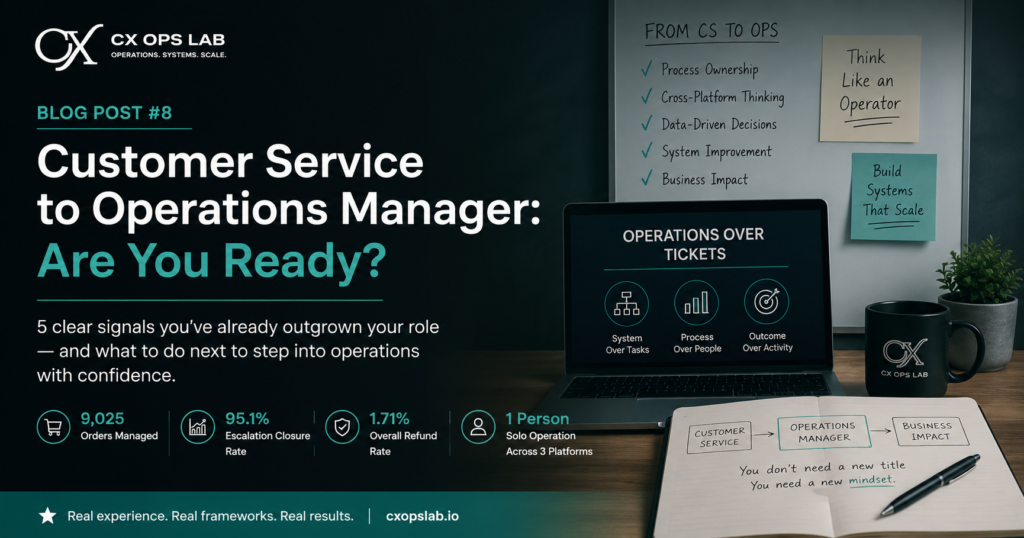
If you’ve started quietly wondering whether the move from customer service to operations manager makes sense for you, there’s a good chance you’re already doing part of the job. In most DTC ecommerce operations, the shift from customer service to operations manager doesn’t happen because someone hands you a new title — it happens because you’ve been absorbing operational responsibility for months, often without anyone officially expanding your scope. This article walks through the exact signals I used to recognize my own move from customer service to operations manager, built from managing 9,025 orders solo across Shopify, Shopee, and Lazada — including three live, simultaneous platform crises and a 1.71% refund rate held across a 9-month operational window.
What “Operations Manager” Actually Means When You Come From CS
The U.S. Bureau of Labor Statistics describes general and operations managers as people who plan, direct, and coordinate the operations of an organization — formulating policy and allocating resources rather than executing individual tasks (BLS, Occupational Outlook Handbook). That distinction matters. The jump from customer service to operations manager is less about a new job title and more about a shift in what you’re accountable for: from resolving the ticket in front of you, to owning the system that determines how every future ticket like it gets handled.
A customer service role is measured in response time and resolution rate. An operations role is measured in whether the system holds up when three things break at once. If you’re already thinking in the second frame — even while your job description still says the first — you’re further along the customer service to operations manager path than your title suggests.
Customer Service Manager vs Operations Manager: What’s the Real Difference?
On paper, a customer service manager and an operations manager can look like adjacent titles. In practice, the customer service to operations manager shift changes what you’re measured on, who you answer to, and what kind of decisions you’re trusted to make without asking first. The table below breaks down the difference the way it actually shows up day to day.
| Dimension | Customer Service Manager | Operations Manager |
|---|---|---|
| Primary responsibility | Resolve individual customer issues well and consistently | Design and own the system that resolves issues at scale |
| Core KPIs | Response time, CSAT, resolution rate | Refund rate, escalation closure rate, cross-platform crisis containment |
| Scope of ownership | A queue, a channel, or a shift | Multiple channels, platforms, or the full customer lifecycle |
| Decision-making authority | Approves individual exceptions within policy | Sets the policy and the exception thresholds themselves |
| Response to a crisis | Answers tickets faster as volume spikes | Freezes scope, maps impact across platforms, sets one response standard |
The pattern across every row is the same: a customer service manager optimizes the response to what already happened. An operations manager builds the system that determines what happens next time. That’s the real dividing line in any customer service to operations manager move — not seniority, not years of experience, but which of those two questions you’re answering by default.
Five Signals You’ve Outgrown a Pure Customer Service Role
1. You’re writing the SOP, not just following it
The first real signal in any customer service to operations manager transition is authorship. Once you start drafting the escalation script, the refund policy exception, or the OOS response sequence — instead of asking someone else what to do — you’ve moved from executing process to owning it.
2. You’re the escalation point across more than one platform
Customer service is usually organized by channel. Operations is organized by outcome. If you’re the person pulled in whenever a Shopify complaint, a Shopee dispute, and a Lazada return start colliding on the same day, you’re already functioning as the operations layer that sits above individual channels — a core part of what a customer service to operations manager move actually looks like in practice.
3. You’re making decisions with margin impact
Approving a one-off refund is a service decision. Deciding the refund threshold for an entire defective batch, and defending that number to a founder, is an operations decision. When your calls start affecting gross margin instead of just one customer’s mood, that’s a clear marker in the customer service to operations manager progression.
4. A single-platform crisis stops being “just a CS problem”
In a real multi-platform crisis, the instinct to treat every fire as a support ticket breaks down fast. If you find yourself mapping affected SKUs across platforms, coordinating with warehouse or supplier timelines, and setting a single company-wide communication standard — rather than just answering faster — you’re already operating several steps ahead of a customer service to operations manager job posting.
5. Your manager already treats you like ops — they just haven’t said it
This is the quietest signal and often the most reliable one. If leadership routes ambiguous, cross-functional problems to you by default, the customer service to operations manager transition may already be informally complete. What’s missing isn’t the responsibility — it’s the title, the pay, and the recognition.
| Metric | Value | What It Signals |
|---|---|---|
| Total orders processed | 9,025 | Volume where ad hoc, memory-based handling starts to break down |
| Crisis cases handled | 95+ across 3 platforms | Ownership spans channels, not a single support queue |
| Escalation closure rate | 95.1% | A repeatable system is closing cases, not individual heroics |
| Overall refund rate | 1.71% | Operational discipline is protecting margin, not just soothing customers |
| Operational period | 9 months | Sustained pattern, not a one-off busy month |
REAL EXAMPLE (GENERALIZED) During a real multi-platform crisis, a product quality incident hit at the same time as an unrelated stock shortage. Customer service instinct says: answer tickets faster. Operations instinct says: freeze the affected SKUs, map every order touched across all three platforms, and set one communication standard before a single reply goes out. That second instinct — systems first, tickets second — is the actual dividing line between customer service and operations management. It isn’t about seniority. It’s about what you reach for first when things go wrong.
The Customer Service to Operations Manager Transition Framework
Recognizing the signals is the easy part. Making the customer service to operations manager transition stick — with a title, a raise, or a new role elsewhere — requires proof, not just instinct. Here’s the three-phase framework I used.
Phase 1 — Document the operational knowledge that’s only in your head
Before you can claim operations-level responsibility, you need something a manager, or a future employer, can actually evaluate. Start writing down the systems you’ve already been running informally: your escalation tiers, your OOS response sequence, your refund decision tree. If none of it exists on paper, it doesn’t exist as far as anyone outside your head is concerned — and it can’t be handed off, which means you can’t be promoted past it.
Phase 2 — Prove impact with numbers, not adjectives
“I handled it well” doesn’t move a customer service to operations manager conversation forward. “I closed 95.1% of escalations across three platforms while holding refund rate at 1.71%” does. Track your own version of these numbers now, even informally, so you have them when the conversation happens.
Phase 3 — Deliberately hand off routine work
You cannot be promoted out of a role you’re still fully occupying. Once your SOPs exist, start delegating the tickets they cover — even informally, even to a peer — so your manager sees you operating one level up before you ask them to formalize it. This is usually the step people skip, and it’s the one that makes a customer service to operations manager case credible instead of aspirational.
Common Mistakes People Make During the Move
- Asking for the title before building the proof — the framework above exists precisely so the ask isn’t the first thing anyone hears.
- Refusing to delegate, because it feels like giving up control — which actually reads as an inability to operate above individual-ticket level.
- Skipping documentation entirely, so no one else can verify that a system exists at all, let alone that you built it.
How to Position the Move — Internally or on LinkedIn
Whether you’re pitching this internally or telling the story publicly, the customer service to operations manager narrative lands best when it’s anchored in specifics: order volume, crisis count, closure rate, refund rate — not adjectives like “hardworking” or “dedicated.” For a fuller breakdown of how solo operational scale translates into a credible case study, see [Solo CX Ops System: What 9,025 Orders Taught Me About Scalable Ecommerce Operations]. For the underlying crisis-response system referenced throughout this piece, [E-commerce Defect Batch Crisis Management: How to Handle It Without Losing Customers or Revenue] walks through the defect batch incident in full.
How Founders Can Spot Future Operations Managers
If you’re a founder or hiring manager reading this instead, the signals above are worth watching for on your own team — because the customer service to operations manager transition is usually visible from the outside well before the person going through it asks for a new title.
- They start bringing you the SOP draft instead of asking what to do — a sign they’re already thinking in systems, not tickets.
- Other CS team members route ambiguous or cross-platform problems to them without being told to.
- They flag margin and refund-rate impact unprompted, not just customer sentiment.
- During a crisis, their first move is to scope and contain — mapping affected orders and platforms — rather than just answering faster.
- You’ve caught yourself already treating them like an operations hire in every way except the title and the pay.
If two or more of these are already true, the honest move is to formalize the customer service to operations manager shift before someone else does — either a competitor, or the employee’s own decision to leave for a role that already matches what they’re doing. The frameworks below are the same ones that make that conversation concrete on both sides of the table.
Build the System Before You Ask for the Title
The fastest way to make a customer service to operations manager case is to already have the documentation a hiring manager or founder would ask for.
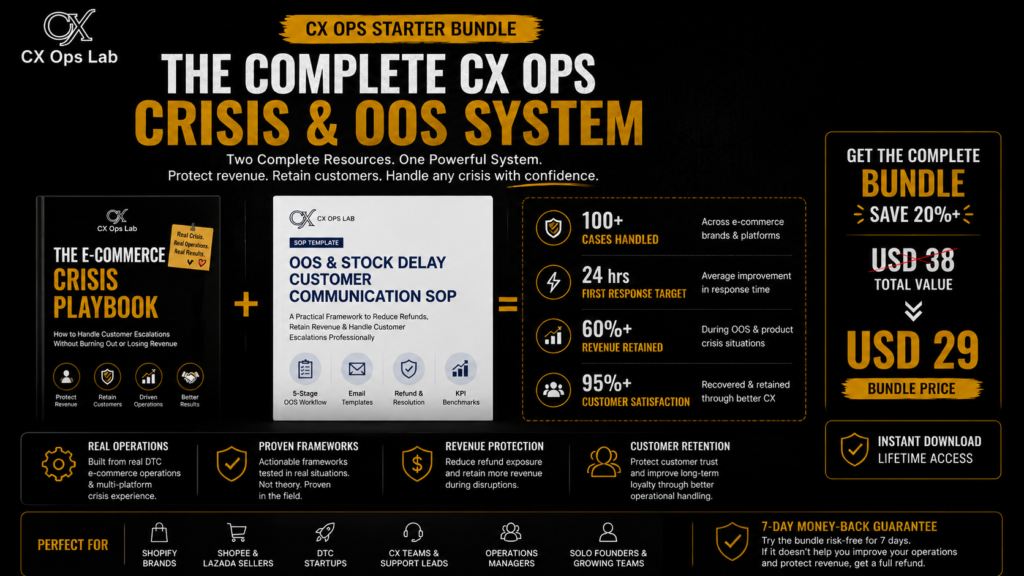
The Ecommerce Crisis Playbook and OOS & Stock Delay SOP Template are the exact frameworks referenced in this article — built from the same 9,025-order, 9-month operation. Get both at a discount in the CX Ops Starter Bundle .
Thinking About Making the Jump?
Moving from customer service into operations means the questions get bigger — not “did we answer the ticket” but “does the system hold up without us.” The Professional Operations Health Check is built around that shift: 25 questions, scored out of 100, across the areas that actually separate a support role from an ops role.
Take the Professional Health Check →
About CX Ops Lab
CX Ops Lab publishes operational frameworks and SOP templates built from real DTC ecommerce experience — managing a multi-platform operation solo across Shopify, Shopee, and Lazada, including live crisis conditions at scale. Explore the full toolkit at payhip.com/CXOpsLab.
Website: cxopslab.io | Products: payhip.com/CXOpsLab