
Two refund requests land in the same inbox on the same afternoon. One is a $40 order, no return needed, closed in under ten minutes. The other is a $340 order, the item shows light signs of use, and it takes three people, two internal message threads and a manager’s judgment call to close four days later. Nothing in the published refund policy explains the gap. A policy tells a customer what they are entitled to. It does not tell the team who gets to decide when a request doesn’t fit the policy page cleanly, and in ecommerce, a large share of refund requests don’t.
That gap is where a refund approval matrix earns its place. A policy is a set of rules written for the customer. A matrix is a decision system built for the team: it assigns who approves what, under which conditions, with which evidence, and at what value threshold. Without one, refund decisions default to whoever is on shift that day, how persuasive the customer sounds, or how much patience is left by four in the afternoon. The business absorbs the cost of that inconsistency in refund rate, in customer trust, and in the hours it takes finance to reconstruct what actually happened after the fact.
Why a Refund Policy Doesn’t Function as a Decision System
Most refund policies read like a legal notice: eligible within 30 days, item must be unused, refund issued to the original payment method. That’s useful for setting customer expectations before a sale. It says nothing about who has authority to approve a refund on a $500 order with no photo evidence, who can waive the 30-day window for a repeat buyer, or what happens when a Shopify order, a Shopee order and a Lazada order raise near-identical exceptions in the same week and land with three different people who each handle it differently.
A policy states the rule. It doesn’t assign the decision. That distinction sounds small until a founder is asked why one customer with a borderline case got a full refund and another with a nearly identical case got store credit. Usually the honest answer is that two different people made the call, on two different days, with no shared reference point beyond “use your judgment.” Judgment isn’t the problem. Judgment with no structure underneath it is.
The Real Cost of Letting Refund Decisions Stay Informal
Inconsistent refund decisions rarely show up as one dramatic failure. They show up as drift. Refund rate creeps upward a few tenths of a percent each quarter because approvers default to yes to avoid conflict. Cycle times stretch because every borderline case gets escalated informally instead of routed to a defined owner. Support agents start guessing what a manager would approve instead of applying a standard, which means the standard effectively doesn’t exist.
In a real multi-platform DTC operation running across Shopify, Shopee and Lazada, holding refund rate at 1.71% against roughly $610,000 USD in gross sales over nine months required exactly this kind of structure underneath the public policy — a defined layer that told the team who owned each type of decision, not a policy page alone. That refund rate wasn’t the product of stricter customer-facing rules. It came from removing ambiguity about who approved what, so exceptions stopped being negotiated case by case and started being routed to a consistent owner with a consistent standard.
Building a Refund Approval Matrix That Actually Gets Used
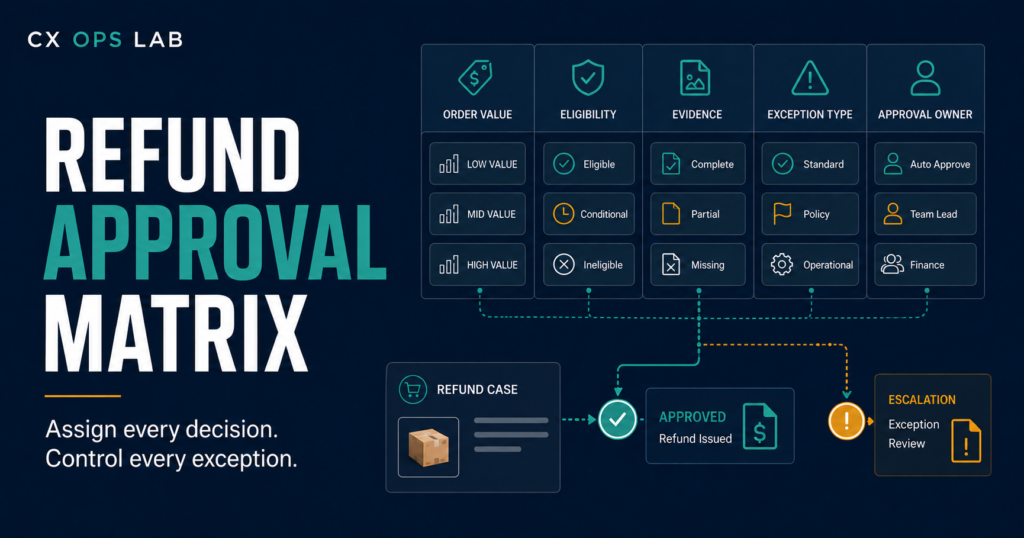
A usable matrix answers five questions for every refund request that reaches it. It doesn’t need to cover every possible scenario — a matrix that tries to anticipate everything becomes another document nobody opens. It needs to cover the variables that actually change who should decide.
- Order value — low-value refunds should clear fast at the frontline; high-value refunds justify a second set of eyes because the financial exposure is different, not because the customer is less trustworthy.
- Eligibility status — a standard, within-window request is a different decision than a borderline one. Conflating them is what makes simple cases slow and complex cases feel arbitrary.
- Evidence required — a refund backed by a photo of a damaged item and a refund backed by nothing but a message shouldn’t clear the same bar. Define what evidence unlocks which approval level before the request arrives.
- Exception type — late requests, product condition disputes, “changed my mind” requests and platform-driven disputes are different problems, each deserving its own row rather than a shared catch-all.
- Approval owner — every row needs exactly one named role with authority to approve it, not a group. Shared ownership is how a $340 refund takes four days: everyone assumes someone else will make the call.
A working matrix might look like this in practice:
| Order Value | Eligibility | Evidence Required | Exception Type | Approval Owner |
| Under $50 | Standard eligible | Order confirmation only | None | Frontline CX agent |
| $50–$150 | Standard eligible | Photo or written note | Late request / missing packaging | Team lead |
| $150–$500 | Standard or borderline | Photo + return tracking | Product condition dispute | Operations manager |
| Over $500 | Any | Photo + return tracking + warehouse verification | Any exception | Founder / senior ops sign-off |
| Any value | Non-standard (past window, damage from use) | Photo + written justification | Policy exception | Named owner, logged reason |
That last row matters more than it looks. Every matrix needs an explicit “this is not standard” lane. Without one, non-standard cases get quietly approved as if they were routine, and the exception rate becomes invisible in the data — which is usually when it starts growing.
A Policy States Rules. A Matrix Assigns Decisions.
This distinction is well established outside ecommerce, in governance and delegation-of-authority literature more broadly. An approval matrix functions as an operational lookup table that maps a specific decision type and dollar threshold to the authority level required to approve it — separate from the policy that defines eligibility, and separate from a RACI-style responsibility chart that clarifies who’s involved in a process without granting anyone the authority to actually commit the business to a decision. Treating a policy page as if it were also a decision system is a common point of confusion, and it tends to stay invisible until an audit, a dispute or a slow quarter forces someone to ask who approved a specific refund, and why.
The related question worth resolving inside the same matrix is when a refund is the right call at all versus a replacement. That decision carries its own cost logic — margin impact, inventory position and customer retention weigh differently depending on the product and the failure reason. A more detailed breakdown of that trade-off is covered in Replacement vs Refund: Which Ecommerce Strategy Actually Protects Your Margin, which pairs well with the approval matrix once value and exception type are defined.
Rolling Out the Matrix Without Freezing the Team
A matrix that takes a month to build and gets ignored in week one isn’t a system, it’s a document. The rollout works better in a narrower order.
- Pull 60 to 90 days of refund cases and sort them by order value and reason. A small number of categories usually covers most of the volume — that’s the raw material for the matrix, not a guess.
- Draft the value tiers and exception rows around that real distribution, not a theoretical one. If most refund volume sits under $100, build the matrix around that reality first.
- Assign one named owner per row, confirmed with that person directly. A matrix nobody agreed to enforce is a matrix nobody follows.
- Pilot it for two weeks on new requests only, without retroactively reprocessing old cases. Track how many requests still get escalated outside the matrix — that number shows which rows are unclear.
- Review exceptions weekly for the first month, then move to monthly once the escalation rate stabilizes. Refund patterns shift as product lines, platforms and order volume change.
This is the same discipline that underpins a broader customer support SOP, not a standalone fix. A refund approval matrix works best sitting inside a documented operating structure rather than as an isolated policy — the kind of foundation covered in the Ecommerce SOP Template built for DTC brands before their first real crisis.
| Stop routing every refund exception through guesswork.The Return & Refund Operations Handbook includes a ready-to-adapt refund approval matrix, an eligibility framework and refund processing checklists built from a real multi-platform DTC operation — so the decision structure above doesn’t stay theoretical.Get the Return & Refund Operations Handbook → |
What Changes Once the Matrix Is in Place
The most visible change isn’t a lower refund rate, at least not immediately. It’s a shorter, more predictable cycle time on the cases that used to stall. A $340 refund with a product condition dispute stops sitting in limbo for four days, because the matrix already answered who decides and what evidence they need before the request ever arrived. The team stops relitigating the same category of exception every time it appears, because the decision was made once, at the policy layer, instead of being remade under pressure every time a customer pushes back.
The second change shows up in the data finance actually trusts. When every non-standard refund is logged against a named approval owner and a documented reason, refund reason analysis stops being a guessing exercise. Leakage caused by inconsistent approvals becomes visible instead of buried inside a single “customer request” catch-all — which is usually where a meaningful share of avoidable refund cost hides in operations that haven’t separated policy from approval authority.
A refund approval matrix isn’t a bigger document than the policy it sits under. It’s a smaller, sharper one — five variables, a handful of rows, one named owner per row. The value isn’t in its length. It’s in the fact that, the next time two similar refund requests land on the same afternoon, the outcome doesn’t depend on who happened to be on shift.
| Build the matrix once instead of relitigating every exception.The Return & Refund Operations Handbook lays out the full refund approval matrix, eligibility criteria and processing workflow used to hold refund rate at 1.71% across a real multi-platform DTC operation — ready to adapt to your own order value tiers and platforms.Get the Return & Refund Operations Handbook → |
About CX Ops Lab
CX Ops Lab publishes operational frameworks, SOP templates, and case-study content built from real DTC ecommerce operations — not theory. Every framework was pressure-tested during live operational conditions across Shopify, Shopee, and Lazada at $610,000+ USD GMV scale.
Website: cxopslab.io | Products: payhip.com/CXOpsLab