
A return comes in on a Tuesday. The support agent checks the order, feels reasonably confident it qualifies, and issues a full refund. On Thursday, a near-identical return comes in — same product, same reason, same order value — and a different agent asks for photos, waits two days, then approves a partial refund. Neither agent did anything wrong. Neither had a document telling them what “right” looks like.
This is what happens without a return and refund SOP. At low order volume the inconsistency is invisible — a founder handling twelve returns a week can hold the whole policy in their head and adjust case by case. Past a few hundred orders a month, that same flexibility becomes a liability: refund amounts drift, warehouse restocking decisions contradict what the customer was told, and finance can no longer explain why the refund rate moved. The fix isn’t a stricter policy page. It’s a return and refund SOP that turns judgment calls into a repeatable sequence — the same twelve decisions, made the same way, every time.
Why the Policy Page Isn’t the Problem
Most stores already have a returns policy published somewhere — 30 days, unworn condition, buyer pays return shipping. That page answers one question: what is the customer entitled to. It says nothing about who approves an exception, what evidence a case needs before a refund is issued, how the warehouse learns that a returned unit shouldn’t go back into stock, or what happens when three of the rules above conflict on the same order.
A policy is customer-facing and static. An SOP is internal and operational — it assigns ownership, sets timing, and defines what “done” looks like at each handoff. Teams that only have the policy tend to discover the gap the same way: a returns backlog builds up during a busy period, refund turnaround time stretches from two days to eight, and nobody can say with confidence why a given case took as long as it did. The backlog is the symptom. The missing SOP is the cause.
The same gap shows up in smaller ways long before a backlog forms. A customer asks why their refund is only partial and the agent has to escalate rather than explain, because the deduction rule lives in someone’s head, not in a document. A returned item sits in the warehouse for a week because nobody was told whether it goes back into sellable stock or gets written off. Finance closes the month and finds the refund total doesn’t match what support logged, because the two teams were tracking the same case in two different places. Individually, each of these is a small friction point. Together, they’re the reason refund operations start to feel harder as volume grows, even though the underlying transactions haven’t changed in complexity.
| If this is already happening in your store: the E-commerce Return & Refund Operations Handbook walks through the full return and refund SOP — the master workflow, tracker structure, refund processing matrix, platform-specific steps for Shopify and Lazada, and the escalation guidelines — built from a real operation that processed 9,025 orders and held a 1.71% refund rate across nine months. It’s the fastest way to replace ad hoc decisions with a documented system. |
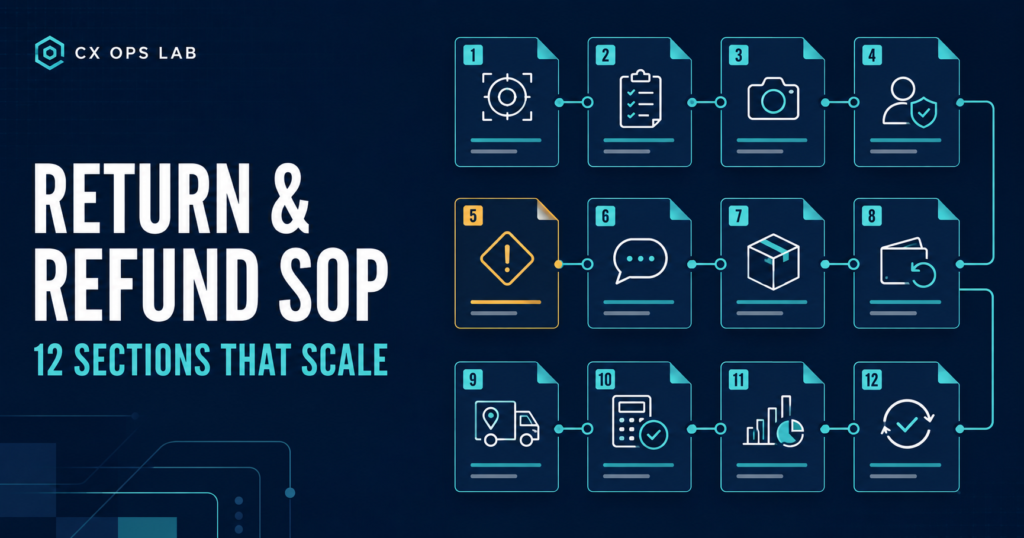
The 12 Sections a Return and Refund SOP Needs
A usable SOP isn’t a single flowchart. It’s a set of small, specific documents that connect to each other. These are the twelve sections that hold up once order volume grows past what one person can track from memory.
1. Scope
Define what the SOP covers before anything else — which products, which sales channels, and which order types are in scope. A DTC brand selling on Shopify, Shopee and Lazada needs to state plainly that return windows, evidence requirements and refund methods can differ by platform, and that the SOP is the master reference each platform-specific process points back to.
2. Eligibility Criteria
Spell out the conditions under which a return qualifies — time since delivery, product condition, proof of purchase, and any category-specific exclusions like final sale or hygiene items. Eligibility should be checkable by a junior agent without needing a manager’s judgment call for the standard case.
3. RMA and Return Authorization
Set the exact steps for issuing a return merchandise authorization: what triggers it, what information the customer must provide, and how the RMA number gets attached to the order so it can be tracked from request to closure. Skipping this step is the most common reason returns “disappear” between systems.
4. Approval Workflow
Not every return should be approved by the person who receives the request. Define value thresholds, exception categories and who signs off on each — this is the difference between a policy that states rules and an approval matrix that assigns decisions to specific people.
5. Refund Processing
Document the mechanics: which refund methods are available, how partial refunds are calculated, and how the internal system of record is updated once a refund is issued. Shopify Payments refunds, for example, are deducted from the store’s next available payout and can show a pending status for up to two business days before the customer’s bank completes the transfer — a detail worth stating explicitly so support agents aren’t guessing when a customer asks where their money is. The SOP should also separate what the store controls (how fast the refund is issued internally) from what it doesn’t (how fast the customer’s bank posts it), because that distinction is what stops agents from over-promising a timeline they can’t guarantee.
6. Exceptions
List the situations that fall outside the standard path — damaged-in-transit claims, wrong item shipped, customer-requested exchange instead of refund — and the different evidence or approval each one requires. An SOP that only covers the clean case will fail on exactly the returns that create the most support tickets.
7. Warehouse Handoff
Define how a returned item moves from “received” to a restocking decision, and who owns that call. This is where return and refund SOPs most often break down in practice: support tells the customer a refund is confirmed, but the warehouse hasn’t yet decided whether the unit is sellable, and the two records disagree. A clear disposition framework closes that gap before it reaches the customer.
8. Customer Communication
Set the message templates and timing for each stage — return approved, item received, refund processing, refund completed. Consistency here matters more than tone; a customer who gets three different updates from three different agents starts a second complaint about the confusion, independent of the original issue.
9. Evidence and Documentation
Specify what evidence a case needs before it can be approved — photos, order screenshots, courier tracking — and where that evidence is stored against the order record. Set a minimum standard once and apply it consistently: if a damage claim requires a photo of the defect and the shipping label in the same request, say so for every case, not just the ones that feel questionable. This section does double duty: it protects the business if a dispute is escalated, and it gives whoever reviews refund trends later something concrete to work from instead of agent notes.
10. Fraud and Abuse Controls
Define the checks that catch return abuse without slowing down legitimate customers — repeat return frequency by customer, mismatched serial numbers, patterns across accounts. US-based sellers should also build refund timing rules around the FTC’s Mail, Internet, or Telephone Order Merchandise Rule, which sets expectations for how quickly a refund must be issued once a shipment can’t be fulfilled as promised. Fraud controls exist to protect margin, not to make every customer feel suspected — the goal is a short list of flags that route a case for a second look, not a blanket policy of suspicion applied to every request.
11. KPIs and Reporting
Pick a small number of metrics the SOP is actually managed against — refund rate, refund turnaround time, repeat-return rate, and reason-code distribution are enough to start. Metrics without an owner tend to get reported once and then forgotten; assign someone to review them on a set cadence.
12. Governance
Name who owns the document, how often it’s reviewed, and how changes get versioned and communicated to the team. An SOP that was accurate eight months ago but never updated is worse than no SOP — agents follow it anyway, and the gap between the document and reality becomes its own source of errors. A short quarterly review, checking each section against the last quarter’s exceptions and escalations, is usually enough to keep the document honest.
What This Looks Like Once It’s Running
None of these twelve sections is complicated on its own. What makes a return and refund SOP hard to build isn’t the individual pieces — it’s getting all twelve to agree with each other, so that what support promises the customer matches what the warehouse actually does, and what finance sees in the refund ledger matches both. A real multi-platform DTC operation that processed 9,025 orders over nine months held a 95.1% escalation closure rate specifically because the operating documents, not individual judgment, carried the weight of consistency once volume made memory unreliable.
The specialist Return & Refund SOP Audit — a 50-question diagnostic built specifically around this framework — is currently in development and will be added to the Audit Center once it’s ready. Until then, the fastest path to a working system is the documented handbook.
Rolling this out doesn’t require rebuilding every process at once. Start with the two sections most likely to be causing today’s friction — usually approval workflow and warehouse handoff, since those are where support and operations most often disagree — document the current state honestly, then fix the gap and move to the next section. A return and refund SOP built this way, one working section at a time, holds up under volume far better than a comprehensive document written in a single sitting and never tested against a real case.
| Build the full return and refund SOP now. The E-commerce Return & Refund Operations Handbook gives you all twelve sections in a ready-to-use format — the master SOP, return tracker guideline, refund processing matrix, platform-specific guides for Shopify and Lazada, exchange/replacement process, tag and macro references, and escalation guidelines — so your team can run a consistent process instead of rebuilding it from scratch every time volume increases.Get the Return & Refund Operations Handbook → |
About CX Ops Lab
CX Ops Lab publishes operational frameworks, SOP templates, and case-study content built from real DTC ecommerce operations — not theory. Every framework was pressure-tested during live operational conditions across Shopify, Shopee, and Lazada at $610,000+ USD GMV scale.
Website: cxopslab.io | Products: payhip.com/CXOpsLab