
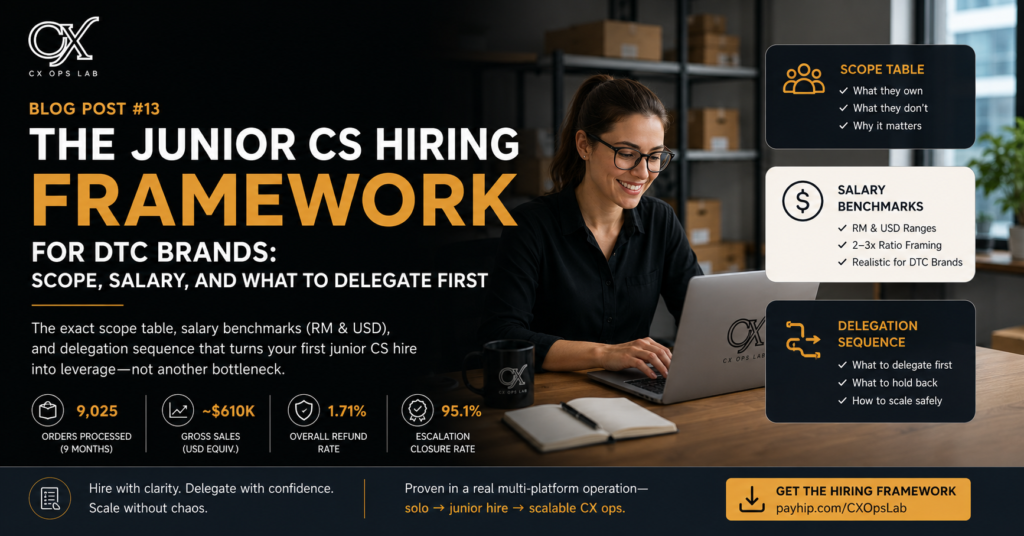
Hiring your first junior customer service hire feels like relief on paper — one more set of hands to answer tickets, process returns, and take pressure off founder-level operations. But most DTC brands make this hire before they have defined what the role actually owns, and an undefined junior customer service hire becomes a second point of confusion instead of a second set of hands. This framework comes from running a solo, multi-platform customer service function across Shopify, Shopee, and Lazada — 9,025 orders processed, roughly $610,000 USD in gross sales, and a 95.1% escalation closure rate across three platforms, all handled by one person before a junior customer service hire ever entered the picture. What follows is the exact scope table, salary framing logic, and delegation sequence that made the eventual hire additive instead of disruptive.
Why Most DTC Brands Get the Junior Customer Service Hire Wrong
Most DTC brands approach a junior customer service hire reactively. The founder or operations lead is drowning in tickets, morale is low, and the hiring decision gets made under pressure rather than under a plan. The result is predictable: a junior customer service hire is brought on with a vague job description like “help with customer service,” no documented workflows to follow, and no clear line between what they can decide and what needs escalation. Within weeks, the hire is either paralyzed by uncertainty or making calls they were never equipped to make.
Single-person dependency is not a staffing model — it is a business risk. A CX operation that only survives a crisis because one person did not sleep is not scalable, and simply adding a junior customer service hire on top of an undocumented system does not fix that. It just adds a second undocumented person to the same fragile setup. Before any hiring conversation starts, it helps to understand exactly where solo operations break down — that’s covered in detail in
Solo CX Ops System: What 7,936 Orders Solo Taught Me About Building a Scalable CX Ops System, which walks through the exact burnout and capacity signals that precede a hiring decision.
Step 1: Document Before You Hire a Junior Customer Service Hire
A junior customer service hire without SOPs is not a hire — it is a more expensive version of the chaos you already have. Before writing a job listing, document the workflows the role will actually run. At minimum, that means:
- A return and refund workflow, written step-by-step, with screenshots where relevant
- Escalation response templates, tiered by severity so a junior customer service hire knows exactly when to hand a case up
- Platform-specific dispute handling notes — Shopify, Shopee, and Lazada each run different SLA rules
- A replacement coordination protocol, from warehouse confirmation through customer delivery
- A crisis activation checklist covering the first 24 hours of any major incident
If these don’t exist yet, the SOP library itself is the higher-priority build. The complete framework for all five documents is broken down in
The 5 SOPs Every DTC Brand Needs Before Their First Crisis Hits — and the E-commerce Crisis Playbook packages the full escalation and delegation structure into a ready-to-use format.
| The SOP-First Rule : If a task can’t be handed to a junior customer service hire using a written SOP, it isn’t ready to be delegated yet — no matter how simple it feels once you know it by heart. |
Step 2: Build a Scope Table Before the Junior Customer Service Hire Starts
The single highest-leverage document you can hand a new junior customer service hire on day one is a scope table — a clear list of what they own, what they don’t, and why. This removes guesswork and protects both the hire and the brand from decisions made above the role’s judgment level.
| Task Category | Junior-Appropriate? | Notes |
|---|---|---|
| Order tracking inquiries | Yes | Macro-based; low judgment required |
| Basic refund status updates | Yes | After SOP training and macro review |
| Return form guidance | Yes | Scripted process, ideally ReturnGo-assisted |
| Ticket categorization & tagging | Yes | After 1–2 weeks of helpdesk system training |
| OOS wait/refund follow-ups | Conditional | Only using pre-approved response templates |
| Complex escalation handling | No | Senior operations ownership only |
| Platform dispute management | No | Requires per-platform SLA expertise |
| Public crisis communication | No | Senior/founder ownership only |
Notice the pattern: everything a junior customer service hire owns on day one is macro-driven, low-ambiguity, and reversible if done imperfectly. Everything reserved for senior ownership involves either irreversible brand exposure or judgment calls that require context a junior customer service hire hasn’t built yet.
One more pattern worth naming: scope creep usually happens gradually, not all at once. A junior customer service hire picks up one exception here, one “just this once” escalation there, and within a few months the line between junior and senior ownership has quietly disappeared. Revisit the scope table monthly during the first two quarters — not to restrict the hire, but to catch drift before it becomes the new, undocumented normal.
Step 3: What a Junior Customer Service Hire Should Never Own First
The instinct once a junior customer service hire is competent with routine tickets is to hand over “everything customer-facing.” Resist it. Three categories should stay with senior ops regardless of how confident the hire becomes early on:
Complex or high-risk escalations
Any case involving repeated contact, an explicit refund demand, a chargeback threat, or aggressive language should route straight to a senior owner. Risk factors compound — a customer with two or three of these signals present needs a handling approach a junior customer service hire has not yet had the reps to calibrate.
Platform dispute management
Shopify, Shopee, and Lazada each apply different SLA windows and evidence requirements for disputes. Getting this wrong doesn’t just cost one case — it can affect account standing across the entire platform relationship. This stays with whoever owns platform strategy.
Any public-facing crisis communication
A comment thread on a live ad, a public review response after a defect complaint, or a mass notification during an out-of-stock event all carry reputational weight beyond the individual case. A junior customer service hire should never be the first or only voice representing the brand publicly during an active crisis.
Step 4: Framing Salary for a Junior Customer Service Hire (Without Meaningless Numbers)
Skip the flat number. A fixed salary figure for a junior customer service hire means very different things depending on cost of living, currency, and local labor market — a number that looks generous in one market reads as insulting in another, and vice versa. What travels across markets is a ratio.
A workable framing: benchmark the junior customer service hire against your local entry-level service or administrative role, then price 1.2–1.6x that rate depending on how much of the scope table above the person owns. Start at the lower end of that range for pure ticket-handling and macro work. Move toward the higher end once the role has absorbed OOS follow-up communication and return-form ownership — scope earns the increase, not tenure alone.
| Why Ratio Beats a Fixed Number : Pay a junior customer service hire relative to local entry-level benchmarks and scope owned — not a flat figure copied from a job board. The ratio holds up whether you’re hiring in Kuala Lumpur, Manila, or Toronto; a fixed number does not. |
Step 5: Tools That Make Delegating to a Junior Customer Service Hire Safer
Delegation is safer when the systems around a junior customer service hire do some of the judgment work automatically. Three categories matter most:
- Helpdesk tagging rules — Richpanel, Gorgias, or Zendesk can auto-flag high-risk keywords (chargeback, legal, refund demand) so escalation-worthy tickets never sit untouched in a junior queue
- Return automation — a tool like ReturnGo removes manual judgment from routine return approvals, keeping a junior customer service hire inside the scripted process instead of improvising
- A living macro library — bilingual where relevant, covering order delay, OOS notification, replacement confirmation, and refund confirmation, so a junior customer service hire is never drafting a first-contact message from scratch
This isn’t a nice-to-have. Zendesk’s own customer service research has repeatedly shown that ticket volume per agent climbs sharply as teams scale, and satisfaction tends to dip in that same growth window — precisely the phase where a first junior customer service hire is usually brought on. Structure absorbs that pressure; an undocumented hire does not.
One caution on tooling: automation should support a junior customer service hire’s judgment, not replace the need for it entirely. Auto-tagging rules and macro libraries reduce ambiguity, but a junior customer service hire still needs to understand why a rule exists — otherwise the first edge case that doesn’t match a template becomes a stalled ticket instead of a sensible escalation.
A 30-60-90 Day Onboarding Plan for a New Junior Customer Service Hire
| Period | Ownership Expands To | Still Owned by Senior Ops |
|---|---|---|
| Days 1–30 | Order tracking, macro-based replies, ticket tagging | All escalations, all refund decisions |
| Days 31–60 | Basic refund status updates, return form guidance | Dispute cases, OOS crisis communication |
| Days 61–90 | OOS follow-ups (templated), routine return approvals | Public-facing replies, platform SLA disputes |
By day 90, a junior customer service hire should be running roughly 60–70% of daily ticket volume independently — while every category in the “never delegate first” list from Step 3 still sits with senior ops.
Are You Actually Ready to Hire a Junior Customer Service Hire?
| Readiness Checklist : Before posting the job listing: the 5 core SOPs are documented, at least 10 escalation macros exist, helpdesk tagging rules are configured, a scope table like the one above is written, and you can name the exact ticket categories staying with senior ops. If any of these are missing, build them first — the hire will succeed or fail based on what’s already in place before day one. |
Turning This Framework Into a Working System
This scope table, delegation logic, and onboarding sequence come directly out of documentation originally built to run a solo, multi-platform CX operation without a team. The full escalation decision tree, macro library, and crisis activation checklist are packaged in the
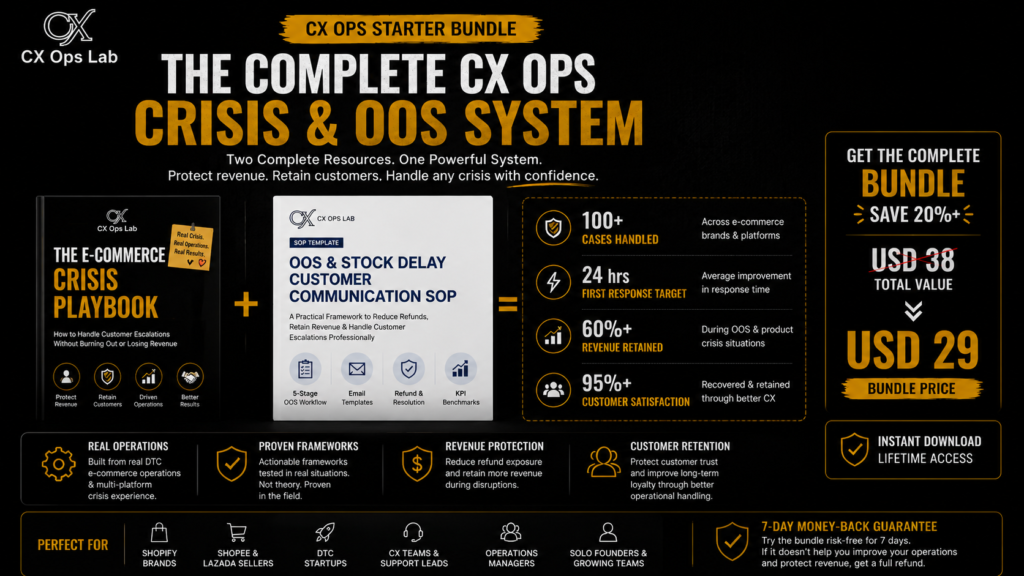
E-commerce Crisis Playbook ($19), paired with the OOS & Stock Delay SOP Template ($19) for out-of-stock scenarios specifically. Both are available together in the CX Ops Starter Bundle ($29, saving 20%) — a practical starting point for any brand documenting a system before their first junior customer service hire starts.
Before You Hire, Know What You’re Actually Handing Off
Hiring solves a capacity problem, not a system problem — if the underlying process isn’t documented, a new hire just inherits the same gaps at a slower pace. The Professional Operations Health Check scores your operation out of 100 across the areas that determine whether a new hire can actually succeed.
Take the Professional Health Check →
About CX Ops Lab
CX Ops Lab publishes operational frameworks, SOP templates, and case-study content built from real DTC ecommerce operations — not theory. Every framework was pressure-tested during live operational conditions across Shopify, Shopee, and Lazada at $610,000+ USD GMV scale.
Website: cxopslab.io | Products: payhip.com/CXOpsLab