

Category: Crisis Management | Reading time: ~8 min
The replacement vs refund ecommerce decision is one of the most margin-critical choices a DTC brand makes during a product complaint.
Every DTC brand faces the same moment eventually: a customer reports a defective product, and your team has to decide — replacement or refund?
The replacement vs refund decision in ecommerce is not just a customer service call. It’s a margin decision, a retention decision, and a signal about how your brand handles accountability. Make it reactively, case by case, with no framework, and you’ll refund your way through a crisis that could have been contained.
This article breaks down the structural difference between replacement-first and refund-first handling strategies — when each applies, what the margin math looks like, and how a replacement-first approach produced a refund rate under 20% across roughly 95 simultaneous complaint cases during a live product crisis.
This is an evergreen framework. The numbers and logic apply whether you’re handling 5 complaints or 500.
What Is the Difference Between a Refund and a Replacement?
A refund returns the customer’s payment in full and closes the transaction permanently — the sale is lost, and the customer relationship effectively ends. A replacement sends a new unit to the customer in exchange for the defective one, keeping the sale intact and the customer inside the brand relationship.
The practical difference between refund and replacement in ecommerce comes down to what happens to margin and retention. A refund costs you the full sale value. A replacement costs you one unit plus shipping. At low complaint volumes the gap is manageable. At scale — or during a product defect crisis — the cumulative difference between these two defaults becomes a significant P&L impact.
The replacement vs refund decision also carries a retention signal: customers whose complaints are resolved with a working replacement tend to purchase again. Customers who receive a refund rarely do.
Replacement vs Refund in Ecommerce: Why the Default Matters More Than the Exception
Most brands don’t have a replacement vs refund policy — they have a refund default with occasional replacements. The difference sounds minor. The margin impact is not.
When a refund is the path of least resistance, two things happen:
- Agents default to it under pressure because it’s faster to process and closes the ticket
- Customers learn it’s available on demand, which increases request frequency over time
A replacement-first framework flips the default. The question stops being ‘should we refund or replace?’ and becomes ‘is there a clear reason not to replace?’ That structural shift changes outcomes at scale.
The default resolution path determines your refund rate far more than individual agent judgment.
Set the right default, and every edge case is an exception. Set the wrong default, and every replacement is a battle.
The Replacement vs Refund Ecommerce Margin Math: What You’re Actually Choosing Between
Before comparing strategies, it helps to understand what each option actually costs. The numbers vary by product and margin structure, but the framework is consistent:
| Cost Factor | Refund | Replacement |
| Revenue recovered | Zero — full loss on original sale | Partial — cost of replacement unit only |
| Customer retained? | Unlikely — they’ve already disengaged | Possible — resolution builds trust |
| Margin impact | 100% of sale margin lost | Cost of goods + shipping only |
| Repeat purchase probability | Low | Higher — complaint resolved positively |
| Processing complexity | Low — one transaction reversal | Medium — requires logistics coordination |
| Risk of further complaint | Low — transaction closed | Low-medium — depends on replacement quality |
The margin gap between these two paths is most visible at scale. On a single complaint, a refund might save 10 minutes of handling time. Across 50 complaints, the cumulative margin leakage from refund-first handling can be significant — especially when the product cost is high and the defect was supply-side, not demand-side.
A replacement costs you one unit. A refund costs you the full sale.
At scale, the replacement vs refund decision is not a customer service question — it’s a P&L question.
Replacement vs Refund Ecommerce Decision Framework: When to Use Each
Neither strategy is universally correct. The replacement-first approach works within a decision framework — not as a blanket rule. Here is the logic structure that determines which path applies:
Use Replacement When:
- The defect is confirmed and supply-side: A manufacturing or batch quality issue justifies a replacement without question.
- The customer is willing to wait: A customer who will accept a defined ETA is a retention opportunity. Forcing a refund is margin loss you didn’t need to take.
- The product is high-value: The higher the unit price, the more margin at stake. Replacement becomes proportionally more valuable.
- The customer relationship has future value: Loyal customers who receive a replacement often have higher LTV than customers who were never complaining.
- Platform dispute hasn’t been opened: Once a Shopee or Lazada dispute is lodged, replacement becomes harder to coordinate. Act before the platform intervenes.
Use Refund When:
- The replacement was also defective: Sending a second defective unit destroys trust faster than the original complaint. If QC on the replacement batch is uncertain, refund.
- The customer is explicitly unwilling to wait: Do not fight for a replacement with a customer who has already decided they want their money back. The escalation cost exceeds the margin saved.
- The defect is safety-related: Any complaint involving potential physical harm should be resolved immediately and cleanly. Refund without friction.
- The platform is about to auto-resolve: If a Lazada or Shopee dispute is approaching auto-refund deadline, issue the refund proactively to maintain control of the resolution record.
- The product is low-margin or high-return-cost: If the logistics cost of a replacement exceeds the margin benefit, a refund may be the correct financial decision.
Replacement vs Refund in Practice: What Real Outcome Data Shows
During a live product quality crisis affecting approximately 95 cases across three sales platforms, a replacement-first framework was applied from the first day of complaint intake. The outcome breakdown across closed cases:
| Resolution Outcome | % of Closed Cases | Margin Impact |
| Replacement completed successfully | ~60% | Cost of goods + shipping only — sale retained |
| Waitstock (replacement pending arrival) | ~17% | Deferred cost — sale retained pending fulfilment |
| Refund issued | ~17% | Full margin loss — necessary cases only |
| Other / escalated | ~6% | Case-by-case resolution |
The refund rate across closed cases stayed well under 20% — during a multi-platform crisis where a refund-first default would likely have produced a rate two to three times higher.
The ‘waitstock’ category is worth noting specifically. Approximately 17% of resolved cases involved customers who agreed to wait for a verified incoming batch rather than accept a refund. These are customers who would have been immediately refunded under a refund-first system — representing direct margin loss that was avoided entirely.
Every waitstock customer is a customer who chose to stay with the brand despite a defect.
That outcome is only possible when the replacement offer is credible, the ETA is specific, and the communication is proactive.
Replacement-First vs Refund-First: Full Strategy Comparison
| Replacement-First Strategy | Refund-First Strategy |
| Default path: offer replacement with ETA | Default path: process refund immediately |
| Refund offered when replacement isn’t feasible | Replacement offered only if customer specifically requests it |
| Requires coordination: logistics, QC, ETA tracking | Requires minimal coordination: payment reversal only |
| Higher retention rate — customer stays in the brand ecosystem | Lower retention rate — transaction is closed and relationship ends |
| Margin impact: cost of goods + shipping | Margin impact: full sale value lost |
| Requires defined decision tree to apply consistently | Easier to apply consistently — no conditions required |
| Works best with: high-value products, confirmed supply-side defects | Works best with: safety defects, repeat failures, unwilling customers |
| Risk: second defective replacement compounds the problem | Risk: refund rate climbs across the team without visibility |
| Outcome at scale: significantly lower refund leakage | Outcome at scale: significant margin erosion during crisis periods |
How to Implement a Replacement vs Refund Ecommerce Decision Framework
The framework only produces consistent outcomes if it’s documented and applied at team level — not left to individual agent judgment. Here’s how to operationalize it:
Step 1 — Define your default resolution path in writing
Your SOP should state explicitly: ‘When a customer reports a confirmed product defect, the first resolution offered is replacement.’ This removes the ambiguity that causes agents to default to refund under pressure.
Step 2 — Build a decision tree for exceptions
Document the conditions under which a refund is appropriate (second defective unit, safety issue, platform deadline, customer refusal). The decision tree should be one page, printable, and referenced in every crisis handling briefing.
Step 3 — Create a waitstock communication template
A replacement-first approach only works if customers trust the ETA. You need a ready-made waitstock email that communicates: what happened, when the replacement stock arrives, and what the customer can expect from the process. Vague ETAs break the agreement.
Step 4 — Tag and track every case outcome
Without tracking, you cannot know your actual replacement vs refund split — and you cannot identify whether the framework is being followed. Tag every case in your helpdesk as: Replacement Completed, Replacement Pending, Refund Issued, or Escalated. Review the distribution weekly during any crisis period.
Step 5 — Review replacement quality before dispatching
The most damaging outcome in a replacement-first strategy is a second defective unit. Before any replacement batch is dispatched, verify quality independently. One bad replacement can undo five successful ones in terms of customer trust.
What Most Brands Miss in the Replacement vs Refund Ecommerce Decision
- They conflate ‘faster’ with ‘better’: Refunds close tickets faster. They don’t produce better outcomes. Speed is a processing metric, not a customer satisfaction metric.
- They have no written default: Without a documented framework, every agent decides individually — producing inconsistent outcomes and uncontrolled refund rates.
- They offer replacement as an afterthought: Presenting replacement as a lesser option (‘we can replace it, but it’ll take a few weeks…’) signals to customers that a refund is the real resolution. Framing matters.
- They don’t track the split: Most brands have no visibility into their real replacement vs refund ratio. They discover the margin problem at month end, not during the crisis.
- They give up on replacement after one objection: A customer who initially declines a replacement may accept it if the ETA is shorter, the communication is clearer, or the offer is framed differently. One objection is not a definitive refund request.
The Replacement vs Refund Ecommerce Decision Is a Systems Problem, Not a Case-by-Case Judgment
The brands with the lowest refund rates during product crises are not the ones whose agents are better at negotiating. They’re the ones with a documented replacement-first framework that removes the path of least resistance as the default option.
A refund rate under 20% across 95 simultaneous crisis cases was not produced by exceptional individual effort. It was produced by a default resolution path, a documented decision tree, and a tracking system that kept every case visible until it closed.
That system is replicable. The replacement vs refund framework above is where it starts.
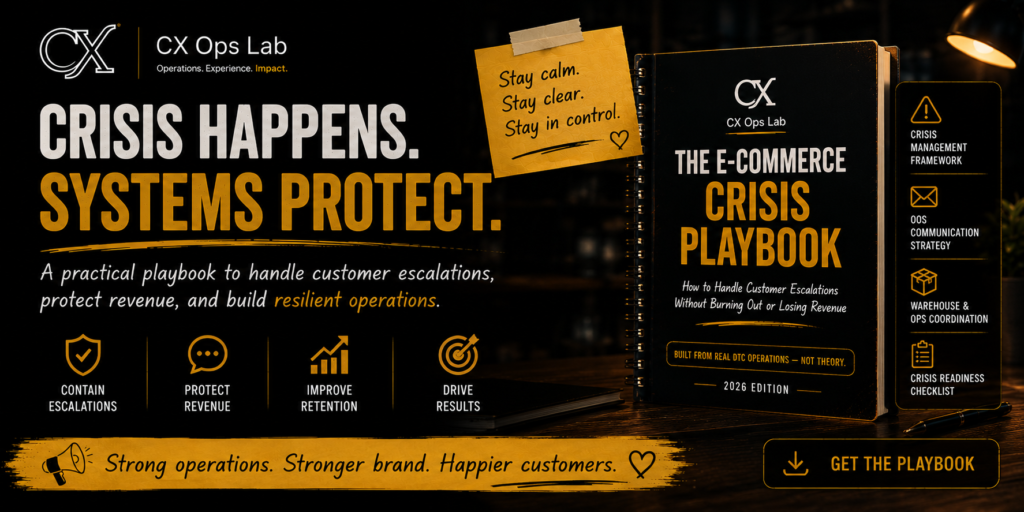
The CX Ops Lab E-commerce Crisis Playbook includes the full replacement-first decision tree, waitstock communication template, and case outcome tracking structure in a plug-and-play format.
→ Available at cxopslab.io
Not Sure Where Your Own Process Stands?
The replacement-vs-refund decision is one piece of a bigger picture. If you’re not sure whether your broader returns and fulfilment process would hold up under real pressure, the free Ecommerce Operations Health Check walks through 25 questions across customer support, fulfilment, returns, and documentation — takes about five minutes, gives you a score and a place to start.
About CX Ops Lab
CX Ops Lab publishes operational frameworks, SOP templates, and case-study content built from real DTC ecommerce operations — not theory. Every framework was pressure-tested during live operational conditions across Shopify, Shopee, and Lazada at $500K+ USD GMV scale.
Website: cxopslab.io | Products: payhip.com/CXOpsLab